
There is a moment of excitement every time you launch a new digital advertising campaign. You set your daily budget, hit “Publish,” and wait for the leads to roll in.
But then the month ends. You check your credit card statement and see that Google or Meta charged you thousands of dollars. You check your inbox, and you only have two unqualified leads to show for it.
Digital advertising is one of the fastest ways to scale a business, but it is also the fastest way to set your money on fire if you don’t know exactly what you are doing. The platforms are designed to make spending money incredibly easy, but generating a profitable Return on Ad Spend (ROAS) requires deep strategy.
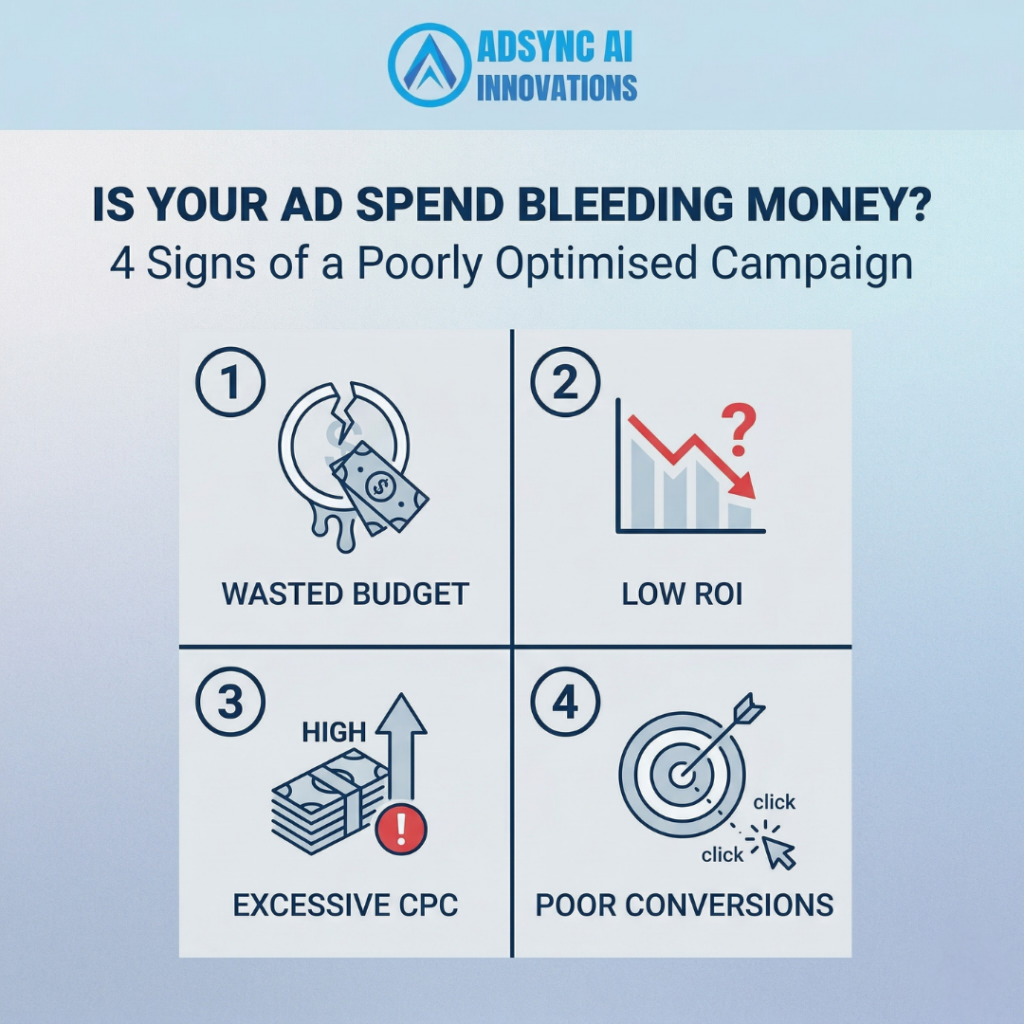
If your cost-per-click is skyrocketing and your conversion rate is sinking, you aren’t alone. Here are four glaring signs that your ad campaign is bleeding money, and exactly how to stop the leak.
TL;DR: The Quick Takeaways
- Broad Match is a Trap: Letting Google decide which searches trigger your ads will drain your budget on irrelevant clicks.
- Negative Keywords are Essential: You need to tell search engines what you don’t want to show up for just as much as what you do.
- The “Bait and Switch” Kills Conversions: If your ad promises one thing but your landing page says another, you are paying for immediate bounces.
- Set It and Forget It Doesn’t Work: Profitable campaigns require constant, weekly babysitting, tweaking, and A/B testing.
1. You Are Relying Entirely on “Broad Match” Keywords
When you build a campaign in Google Ads, the platform defaults your keywords to “Broad Match.” This means Google will show your ad to anyone searching for phrases it deems somewhat related to your keyword.
Let’s say you run a financial services firm, and you bid on the keyword “tax professional.” Because it is on Broad Match, Google might show your expensive ad to a college student searching for “how much does a tax professional make” or “free tax software.” Every time someone clicks that ad, you pay. But those people are never going to hire you.
The Action Step: Take control of your targeting. Use “Phrase Match” (putting quotes around your keywords, like “tax consultant near me”) or “Exact Match” (using brackets, like [corporate tax filing]) to ensure your ad only triggers when the search intent exactly aligns with the services you provide.
2. You Don’t Have a “Negative Keyword” List
A negative keyword list is the ultimate defence mechanism for your ad budget. It tells Google exactly which words should prevent your ad from showing.
For example, imagine you are managing ads for a premium, private healthcare hospital. You are bidding on terms like “specialist consultation.” If you don’t have a negative keyword list, your ad will show up when people search for “free public hospital” or “cheap medical advice.” You are paying for clicks from people looking for free services, which completely drains the budget meant for qualified patients.
The Action Step: Build a robust negative keyword list immediately. Common negative keywords for service-based businesses include words like free, cheap, DIY, how to, template, jobs, salary, and course. Block the bargain hunters from clicking your ads.
3. Your Ad and Your Landing Page Don’t Match
We call this the digital “Bait and Switch.”
Let’s say you are a logistics company running an ad promoting specialised sea shipping routes to Dubai. The user clicks the ad, expecting to see shipping rates, schedules, and a contact form for sea freight. Instead, they are dumped onto your generic homepage, forcing them to hunt for the specific shipping information they clicked on.
What happens? They get frustrated and hit the “back” button. You still pay for the click, but you lose the lead.
The Action Step: Never send paid ad traffic to your homepage. Every specific ad group needs its own dedicated, highly relevant landing page. If the ad talks about sea shipping, the landing page must only talk about sea shipping. Match the headline of your ad to the headline of your landing page to create a seamless, high-converting user experience.
4. You Think Paid Ads are “Set It and Forget It”
The most expensive mistake a business owner can make is building an ad campaign, turning it on, and not looking at it again for a month.
The digital advertising landscape changes daily. Competitors adjust their bids, new search trends emerge, and ad copy gets stale. If you aren’t actively monitoring your campaigns, your Cost Per Click (CPC) will inevitably creep up while your results decline.
The Action Step: Paid ads require active management. At a minimum, you should be checking your campaigns twice a week. You need to pause underperforming ads, allocate more budget to the winning ads, add new search terms to your negative keyword list, and continuously A/B test new headlines to see what drives the cheapest conversions.
Stop Funding Google. Start Funding Your Growth.
Running profitable ad campaigns isn’t about throwing more money at the platform; it is about surgically optimising your strategy so that every dollar you spend works to acquire your ideal customer.
If your current ad account feels like a black hole, it is time to bring in the experts. Stop guessing with your marketing budget.
Ready to turn your ad spend into actual ROI? The team at Adsync Marketing specialises in auditing, rebuilding, and scaling high-performance digital ad campaigns.
- Call us: +91 93802 22322
- Email us: info@adsyncmarketing.com
- Visit: https://adsyncmarketing.com/