
You and your team sit around a conference table looking at the new design for your website’s homepage. The CEO loves the blue button. The sales manager thinks the headline should be punchier. The graphic designer wants to use a sleek, abstract image instead of a photo of the team.
So, how do you decide who is right? In most businesses, the final decision comes down to the HiPPO—the Highest Paid Person’s Opinion.
But here is the harsh truth about digital marketing: your opinion doesn’t pay the bills, and neither does your CEO’s. The only opinion that actually matters is your customer’s. When you make marketing decisions based on what “looks good” rather than what the data shows, you leave massive amounts of money on the table.
To scale predictably in 2026, you have to stop guessing and start testing. Here is how A/B testing turns marketing from a guessing game into a profitable science.
TL;DR: The Quick Takeaways
- Data Over Ego: A/B testing removes personal bias from marketing decisions. The numbers never lie.
- Test One Variable at a Time: If you change the headline, the image, and the button color all at once, you won’t know which change actually caused the spike in sales.
- Micro-Changes, Macro-Results: A simple word change on a button can increase your conversion rate by 20%, compounding into massive revenue over a year.
- Test the High-Impact Areas First: Don’t waste time testing the color of your footer text. Focus on Headlines, Offers, and Call-to-Action buttons.
1. What Exactly is A/B Testing?
A/B testing (also known as split testing) is the scientific method applied to digital marketing.
Instead of launching a single version of a webpage or ad and hoping it works, you create two versions: Version A (the original) and Version B (the variation). You then split your live website traffic or your ad budget 50/50 between the two versions.
You let the test run for a few weeks, then look at the data to see which version generated more leads, more clicks, or more sales. The winner becomes your new permanent baseline, and you start the testing process all over again.
2. The Power of Micro-Changes
Many business owners think that to double their leads, they need to redesign their entire website or double their ad budget completely. Often, the solution is much cheaper and much simpler.
Imagine you run a B2B software company. You are spending ₹1,00,000 a month driving traffic to a landing page that converts at 2%. That means you are getting 200 leads a month.
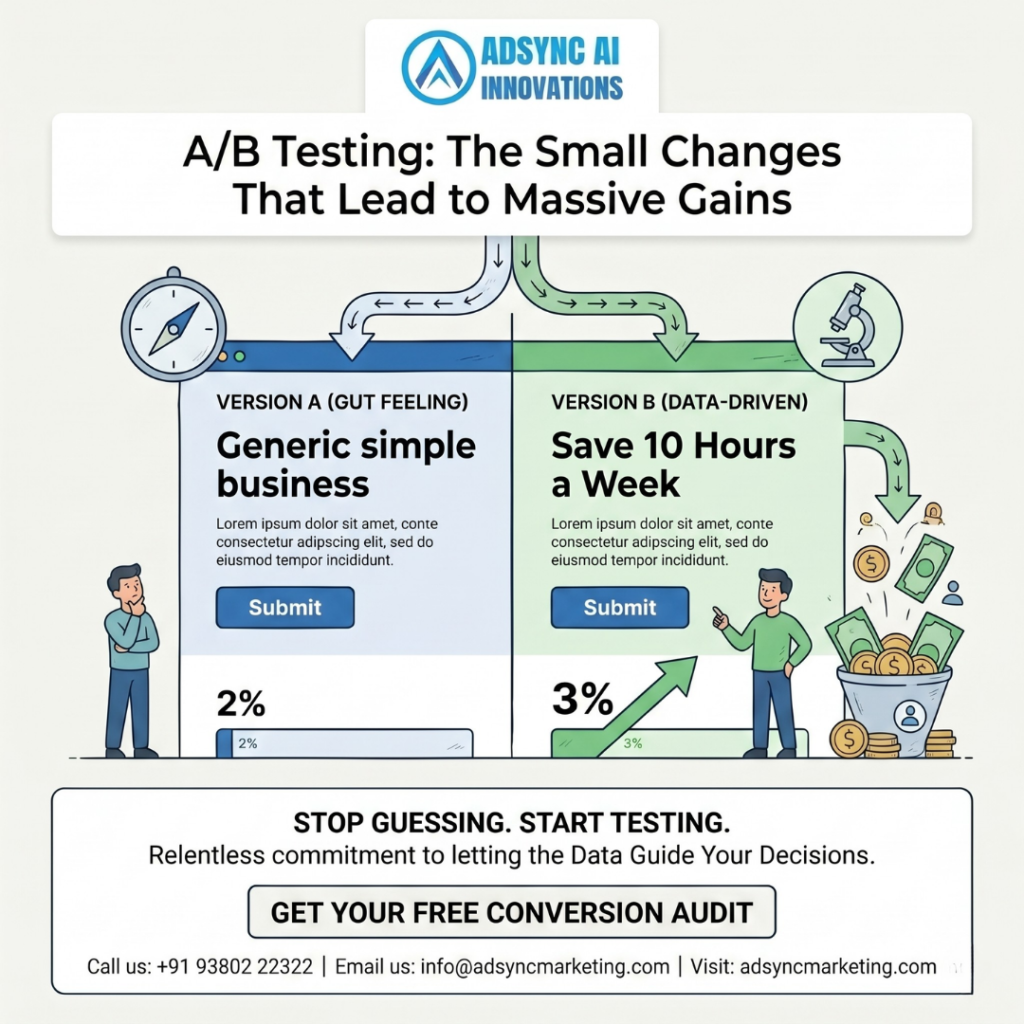
You decide to run an A/B test. You keep everything the same, but you change the headline from a generic “Software for Growing Businesses” to a specific, benefit-driven “Automate Your Workflow and Save 10 Hours a Week.”
Because the new headline is clearer, your conversion rate jumps from 2% to 3%. You didn’t spend a single extra Rupee on ads, but you are now generating 300 leads a month instead of 200. That 1% increase in conversion rate just resulted in a 50% increase in total leads. That is the magic of compounding micro-changes.
The Action Step: Look at your highest-traffic page. What is the one element you could tweak today that might make a user more likely to stay?
3. What Should You Actually Test?
You can test almost anything on the internet, but if you want the highest Return on Investment, you need to focus on the elements that directly impact the user’s decision to buy.
- The Headline: The most important element on any page or ad. Test clarity versus cleverness. Test long-form versus short-form.
- The Call to Action (CTA): Test the color of the button (does green get more clicks than blue?). Test the copy—compare “Submit” against “Get Your Free Quote.”
- The Hero Image: Does your audience prefer a picture of the product itself or a happy human using it?
- Form Length: If your “Contact Us” form has 8 fields, test a version that only asks for Name, Email, and Phone Number. Shorter forms almost always convert higher.
4. The Golden Rule: One Variable at a Time
The biggest mistake amateur marketers make is running a “muddy” test.
Let’s say your Google Ad isn’t performing well. So, you create a new ad with a brand new headline, a different image, and a completely different offer. Suddenly, the new ad starts getting twice as many clicks!
You celebrate, but you have a massive problem: Why did it win? Was it the headline? Was it the image? Because you changed three things at once, you learned absolutely nothing about your audience’s psychology.
The Action Step: Be disciplined. If you are testing an ad or a landing page, duplicate it and change only one thing. If you test the headline, leave the image and the buttons the same. When the test is over, you will know with 100% certainty what drove the result.
Turn Your Marketing into a Science
Great marketing isn’t about having a genius “gut feeling.” It is about having a relentless commitment to letting the data guide your decisions. When you embrace A/B testing, you stop debating what looks best in a boardroom and start letting your customers tell you exactly how they want to be sold to.
Are you tired of guessing what works? Stop leaving your revenue up to chance. The Conversion Rate Optimization (CRO) experts at Adsync Marketing use rigorous A/B testing to continuously improve your campaigns and squeeze every drop of ROI out of your budget.
- Call us: +91 93802 22322
- Email us: info@adsyncmarketing.com
- Visit: https://adsyncmarketing.com/