
Think about the last time you bought something significant—maybe a new piece of software for your business, or a high-end appliance for your home.
Did you see a Facebook ad, click it, and immediately hand over your credit card? Absolutely not.
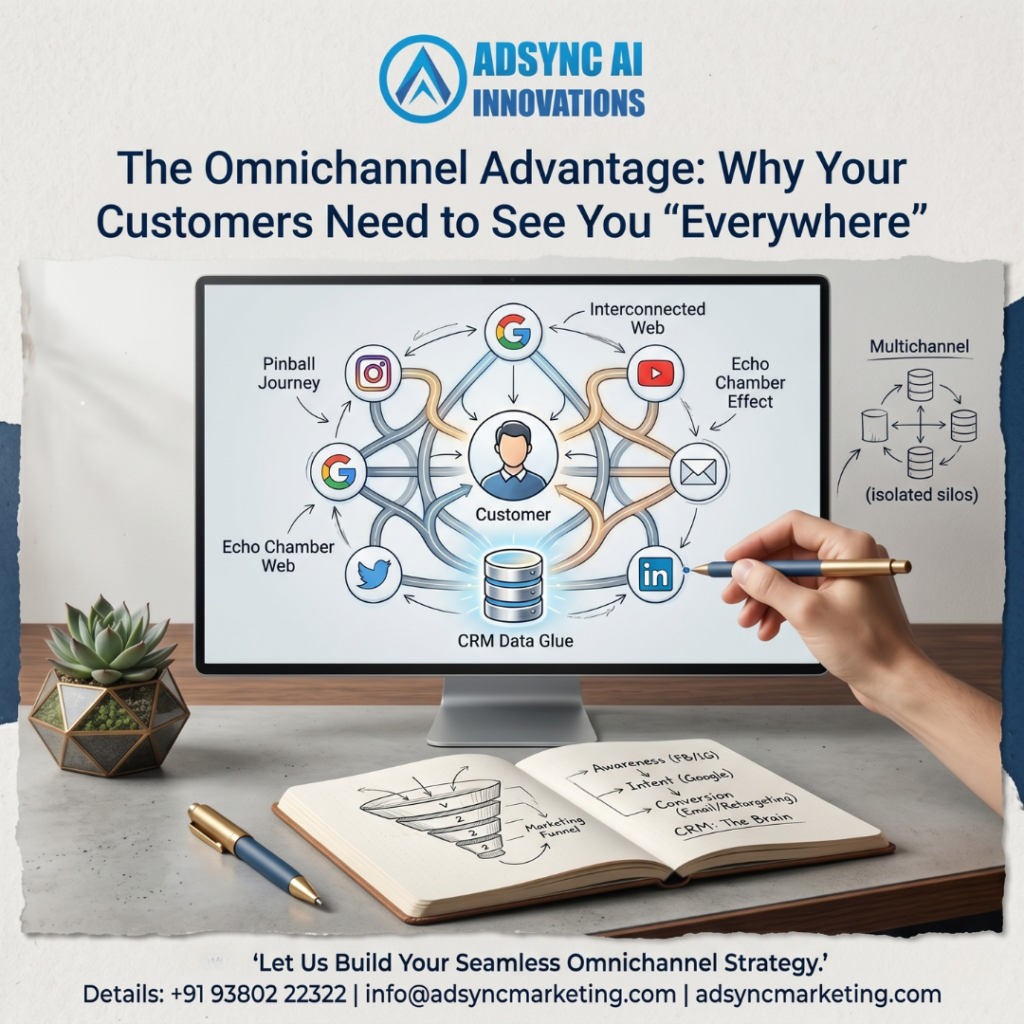
Your buying journey probably looked more like a pinball machine. You saw an ad on Instagram while waiting in line for coffee. You closed the app. Two days later, you remembered the product and Googled it on your work laptop. You browsed the website but got distracted by an email. A week later, you saw a retargeting video on YouTube, clicked the link, and finally made the purchase.
If that company had only invested in Facebook ads and ignored Google SEO, it would have lost you. If they didn’t have a YouTube retargeting campaign, they would have lost you.
The modern consumer journey is chaotic. To capture today’s buyer, you cannot rely on a single platform. You need an Omnichannel Strategy—a seamless, interconnected web of marketing touchpoints that surrounds your prospect until buying becomes the only logical conclusion.
TL;DR: The Quick Takeaways
- The “Pinball” Journey: Consumers bounce between devices and platforms before making a purchase. You need to be waiting for them at every stop.
- Multichannel vs. Omnichannel: Having a Facebook, an email list, and a website is multichannel. Making sure they all communicate seamlessly with each other is omnichannel.
- The “Echo Chamber” Effect: When a prospect sees your brand on LinkedIn, Google, and in their inbox all in one week, you appear massive and undeniably authoritative.
- Data is the Glue: You need a centralized CRM to track user behavior across different platforms so your messaging stays relevant.
1. Multichannel vs. Omnichannel (Know the Difference)
Many business owners confidently state, “We are everywhere! We have a blog, an email newsletter, Google Ads, and an Instagram page.”
That is Multichannel. You have a presence on multiple channels, but they operate in completely isolated silos. Your email team doesn’t know what your social media team is doing, and the user experiences a disjointed, clunky brand narrative.
Omnichannel puts the customer at the absolute center. The channels talk to each other. If a user adds a ₹4,000 product to their cart in your mobile app but doesn’t check out, they don’t just get a generic app notification. Later that evening, they see an Instagram ad featuring that exact product, and the next morning, they receive a highly personalized email offering free shipping to complete the purchase. The experience is frictionless.
The Action Step: Do a friction audit. Go through your own buying process from a smartphone, then switch to a desktop halfway through. Does the experience seamlessly carry over, or are you forced to start over from scratch?
2. The Psychology of the “Echo Chamber.”
There is a psychological phenomenon known as the Baader-Meinhof Phenomenon (also called the frequency illusion). It is what happens when you buy a new car and suddenly start seeing it everywhere on the highway.
Omnichannel marketing weaponizes this psychology.
When you run a coordinated campaign, a prospect reads your thought-leadership article on LinkedIn on Tuesday. On Wednesday, they searched a related question on Google, and your website ranks #1. On Friday, they get an educational email from your CEO.
Because you are showing up in different contexts, their brain subconsciously registers your company as the undisputed leader in your industry. You have built an echo chamber of trust.
The Action Step: Sync your messaging across all platforms. If you are running a promotional campaign for a new SaaS product in Q3, your website hero banner, Facebook ads, LinkedIn posts, and email signatures must all push the same visual and offer simultaneously.
3. Don’t Be Annoying (The Importance of Sequencing)
Being “everywhere” does not mean aggressively spamming your audience with the same “Buy Now!” ad on every platform. That is a guaranteed way to exhaust your audience and damage your brand.
A true omnichannel strategy relies on sequential storytelling. You use different platforms to serve different purposes in the funnel.
- Platform 1 (Facebook/Instagram): Introduce the problem. (Awareness)
- Platform 2 (Google Search): Provide the solution when they actively look for it. (Intent)
- Platform 3 (Email/Retargeting): Offer social proof, case studies, and a final call-to-action. (Conversion)
The Action Step: Map out a 3-step sequence for your next campaign. Instead of running three identical ads, create a “Part 1, Part 2, Part 3” narrative that guides the user from curiosity to trust to purchase, using a different medium for each step.
4. The Data Glue: Your CRM
You cannot execute an omnichannel strategy using spreadsheets and sticky notes. The only way to know that the person who clicked your Instagram ad is the same person who just subscribed to your email list is by using a centralized Customer Relationship Management (CRM) system.
Your CRM acts as the brain of your marketing operation. It collects data from every touchpoint—social, search, email, and sales calls—and builds a unified customer profile. This allows you to personalize your marketing at scale.
The Action Step: If you are not currently using a CRM (like HubSpot, Salesforce, or ActiveCampaign) to track your leads, stop spending money on ads until you get one set up. You are driving blind without it.
Stop Marketing in Silos
Your customers don’t live in just one app, and your marketing shouldn’t either. When you connect the dots and create a unified, omnipresent brand experience, you stop fighting for attention and start capturing the market.
Are your marketing channels operating in the dark? Managing an omnichannel strategy requires deep technical expertise and seamless coordination. The team at Adsync Marketing acts as the conductor of your digital orchestra, ensuring every platform works together to drive measurable revenue.
- Call us: +91 93802 22322
- Email us: info@adsyncmarketing.com
- Visit: https://adsyncmarketing.com/