
Imagine walking into a networking event. You meet someone new, shake their hand, and for the next twenty minutes, they do nothing but talk about themselves. They talk about their awards, how long they’ve been in business, and how great their services are. They never once ask about you or your business.
You would politely excuse yourself and walk away as fast as possible.
Unfortunately, this is exactly how 90% of business websites read. Business owners mistakenly believe that their website is an online brochure designed to brag about their company’s history and accolades.
Here is the harsh reality of digital marketing: your customers do not care about you. They do not care that you were founded in 1998, and they do not care that you are “committed to excellence.” They only care about one thing: Can you solve my specific problem?
If your website traffic isn’t converting into leads, your design might not be the issue—your words are. Here is how to write website copy that stops readers in their tracks and forces them to take action.
TL;DR: The Quick Takeaways
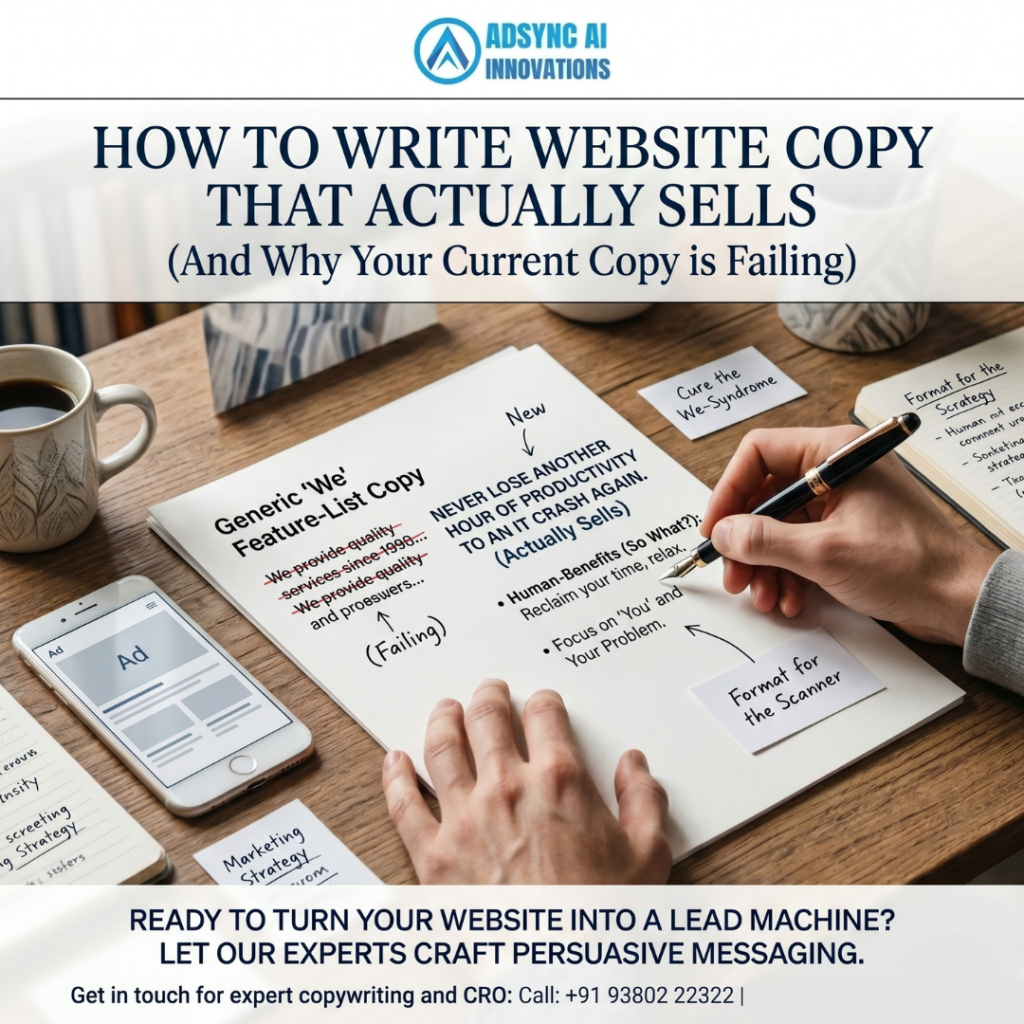
- Cure the “We” Syndrome: If every sentence on your homepage starts with “We” or “Our,” you are alienating your buyer. Switch the focus to “You.”
- Features Tell, Benefits Sell: Don’t just list what your product does. Explain exactly how it improves the customer’s life.
- Agitate the Pain: People are highly motivated by avoiding pain. You must remind them of the cost of doing nothing before you present your solution.
- Nobody Reads Anymore: Modern internet users scan. Break up massive blocks of text with bullet points, bolded phrases, and clear subheadings.
1. The “You” vs. “We” Ratio
The fastest way to instantly improve your website’s conversion rate is to perform the “We/Our” audit.
Go to your homepage right now and count how many times you use the words We, Our, Us, or your company name. Then, count how many times you use the words “you” or “your.”
If the “We” count is higher than the “You” count, your website is an ego trip. When a prospect lands on your site, they want to feel understood. The hero of the story should be the customer, not your brand. Your brand is simply the trusted guide helping the hero win the day.
The Action Step: Rewrite your headlines so the customer is the subject of the sentence.
- Instead of: “We provide the best corporate IT solutions in Bengaluru.”
- Write: “Never lose another hour of productivity to an IT crash again.”
2. The “So What?” Framework (Features vs. Benefits)
Businesses love to list their features. But features are boring, logical facts. Humans make purchasing decisions based on emotion, and then use logic to justify them later.
If you sell a B2B SaaS platform and your headline says, “Our software features end-to-end 256-bit encryption,” the non-technical CEO reading that is going to think: “So what?”
You have to translate that feature into a human benefit. What does 256-bit encryption actually give them? It gives them peace of mind. It keeps them out of legal trouble.
The Action Step: For every feature you list on your website, ask yourself, “So what?”
- Feature: 24/7 Customer Support. (So what?)
- Benefit: You will never be left alone in an emergency, even at 3:00 AM on a Sunday.
3. Don’t Be Afraid to Agitate the Pain
In psychology, it is a proven fact that human beings are far more motivated to avoid pain than they are to acquire pleasure. (Losing ₹10,000 feels much worse than finding ₹10,000 feels good).
Yet, most businesses are afraid to talk about the negative. They only want to talk about how great their solution is. But if you do not remind the prospect of how painful their current problem is, they won’t feel any urgency to buy your solution.
If you are a commercial roofing contractor, don’t just talk about the quality of your shingles; talk about the quality of your work. Talk about the nightmare of a sudden leak ruining a warehouse full of inventory. Remind them of the pain, and then immediately present yourself as the cure.
The Action Step: Dedicate a section right below your main website header to “The Problem.” Use three simple bullet points to describe the exact frustrations your ideal client is facing right now. When they read it, they should think, “Wow, it’s like they are reading my mind.”
4. Format for the “Scanner.”
You can write the most brilliant, persuasive copy in the world, but if you format it into massive, dense paragraphs, absolutely no one is going to read it.
Modern internet users do not read websites like they read books; they scan. They scroll down rapidly, looking for bold words, bullet points, and headers that catch their eye. If they see a wall of text, their brain perceives it as “work,” and they will bounce.
The Action Step: Chop your paragraphs in half. No paragraph on your website should be longer than three sentences. Use bulleted lists whenever possible. Bold the most important phrases so that even if a user only reads the bold words, they still understand your core message.
Stop Selling and Start Solving
Great copywriting isn’t about being clever, using big corporate words, or tricking people into buying. It is about extreme clarity. When you clearly articulate your customer’s problem better than they can themselves, they will automatically assume you have the solution.
Is your website beautiful, but completely failing to generate leads? You don’t need a new design; you need a new message. The copywriting and CRO experts at Adsync Marketing craft persuasive, customer-centric messaging that turns casual scanners into highly qualified leads.
- Call us: +91 93802 22322
- Email us: info@adsyncmarketing.com
- Visit: https://adsyncmarketing.com/