
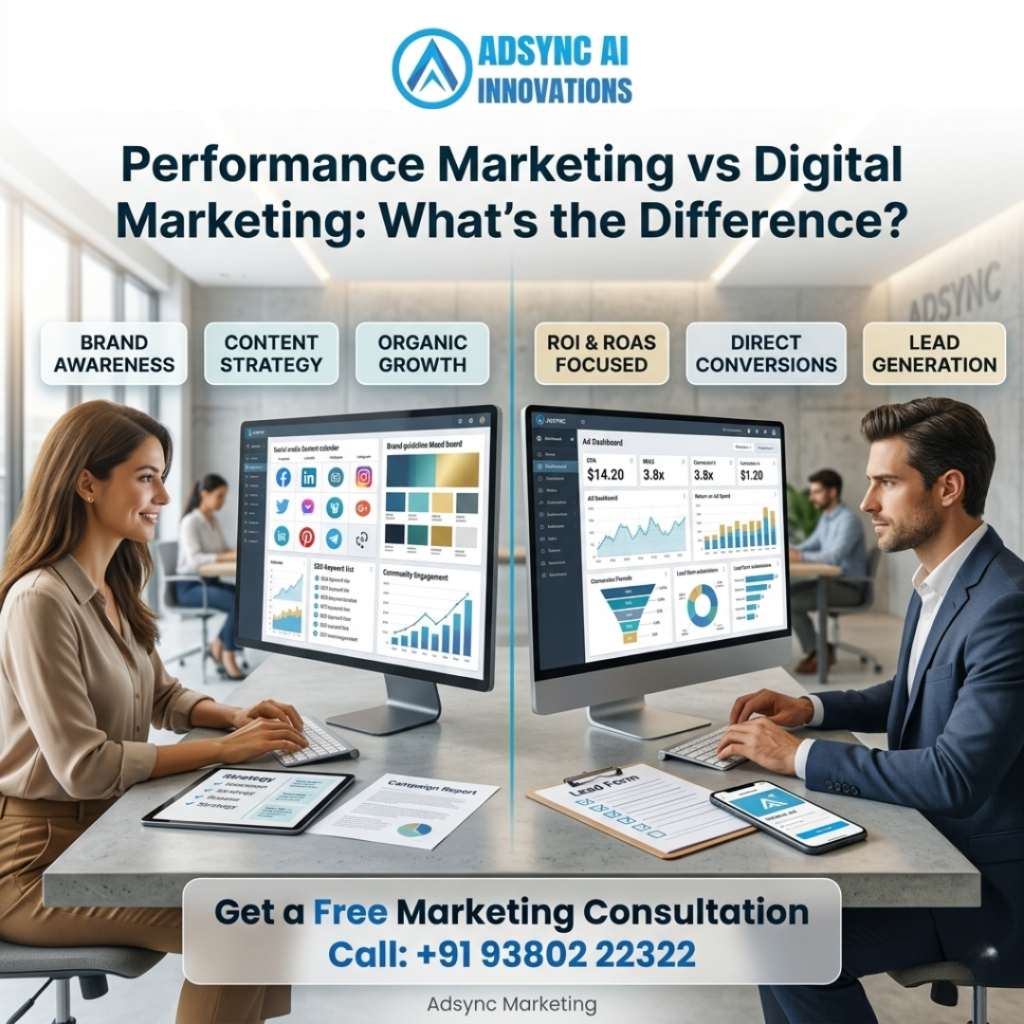
Currently, you might be running a growing business. For instance, you could be scaling a SaaS startup, launching a D2C ecommerce brand, or managing a local service company. Consequently, you have probably sat in a meeting and heard dozens of marketing terms thrown around.
Eventually, the conversation usually boils down to two main concepts. Specifically, people debate digital marketing versus performance marketing.
Therefore, founders and business owners often ask a critical question. Should you hire an agency to build your overall brand, or should you pour your budget strictly into performance marketing to get immediate sales?
Ultimately, understanding the difference between the two isn’t just about learning industry jargon. Instead, it is about knowing how to spend your budget effectively so your business actually grows.
Let’s skip the textbook definitions. Here is a practical, no-nonsense breakdown of performance marketing vs digital marketing, how they work, and exactly when your business needs them.
What is Digital Marketing? (The Big Picture)
First, digital marketing serves as a broad umbrella term. It covers absolutely every action you take online to build your brand, connect with your audience, and eventually drive sales.
Think of digital marketing as the foundation of your online house. For example, it includes your website design, search engine optimization (SEO), and educational blog content. Furthermore, it encompasses your organic social media presence and your email newsletters.
The primary goal here involves brand awareness, authority, and relationship building. You want people to know who you are, like what you have to say, and trust you enough to buy from you eventually.
A Simple Example for Indian Businesses: Imagine you run a fast-growing organic skincare brand. Your digital marketing efforts would include posting behind-the-scenes videos of product manufacturing. Additionally, you might write blogs about healthy skincare routines and send out weekly email tips. These activities might not trigger an immediate purchase. However, they build immense trust. Consequently, when that customer is finally ready to buy a face serum, your brand comes to mind first.
What is Performance Marketing? (The Laser Focus)
If digital marketing represents the entire house, performance marketing acts as the highly optimized sales counter inside it.
Specifically, performance marketing is a subset of digital marketing where you only pay when a specific action occurs. That action could be a click, a lead form submission, a booked meeting, or a direct sale.
Therefore, you aren’t paying for someone to simply “see” your brand. Instead, you pay strictly for results. This includes channels like Google Search Ads, Meta Ads, LinkedIn sponsored content, and affiliate marketing.
Because you track everything down to the exact rupee, performance marketing remains highly measurable. Consequently, you know exactly how much you spent to acquire a single customer.
A Simple Example for Indian Businesses: Let’s look at a B2B SaaS startup based in Bangalore selling HR software. They don’t want to build awareness; they need demo bookings right now to hit their quarterly targets. Therefore, they launch a targeted LinkedIn ad campaign offering a free 14-day trial to HR managers. For every ₹1,000 they spend, they know they get one qualified software demo. Ultimately, that is performance marketing—predictable, mathematical, and conversion-driven.
The Real Differences: A Practical Comparison
To make building your digital growth strategy easier, we need to compare the two approaches. Here is how they stack up across the metrics that matter most to your bottom line.
| Feature | Digital Marketing | Performance Marketing |
| The Primary Goal | Builds brand equity, audience engagement, customer education, and long-term loyalty. | Drives a specific, immediate action like a sale, an app install, or a lead submission. |
| Timeframe for Results | A Marathon: It takes months to rank organically on Google or build a loyal social community. | A Sprint: You can launch a Google Ad campaign in the morning and see new sales by the afternoon. |
| How You Measure Success | You track website traffic, social media followers, time spent on your page, and email open rates. | You track hard numbers: Cost Per Click (CPC), Cost Per Acquisition (CPA), Return on Ad Spend (ROAS), and conversions. |
| Budget Flexibility | Requires a steady, consistent investment in talent (writers, designers) regardless of daily returns. | Highly scalable. If a campaign succeeds, you double the budget. If it fails, you turn it off instantly. |
When Does Your Business Need Which?
One of the most common mistakes startups make involves choosing the wrong strategy for their current stage of growth.
You should focus heavily on Performance Marketing when:
- You need immediate cash flow: If you just launched a new product and need to prove traction to investors, targeted ads will get you customers immediately.
- You have a strictly monitored budget: If you need to guarantee a return on investment to survive the month, performance ads offer total financial control.
- You are testing an offer: Want to know if your new pricing model works? Run traffic to a landing page for a week and watch the conversion data.
You should focus heavily on broader Digital Marketing when:
- You operate in a high-trust industry: If you run a wealth management firm or a healthcare clinic, people don’t just click an ad and hand over their money. Therefore, you need blogs, patient testimonials, and authority-building content.
- Your Customer Acquisition Costs (CAC) are rising: Ad platforms get more expensive every year. Building strong organic traffic ensures ad platforms do not hold your profit margins hostage.
- You want to build a memorable brand: Ads can buy you a single transaction. However, organic digital marketing buys you a loyal customer for life.
Why Both Should Work Together
The reality is that asking “performance marketing vs digital marketing” is a bit of a trick question. Ultimately, the most successful businesses don’t choose between them. Instead, they seamlessly integrate them.
Think about how you behave as a consumer. First, imagine you are scrolling through Instagram and see a highly targeted performance marketing ad for an ergonomic office chair. You click the ad. It looks perfect.
But do you buy it immediately? Probably not.
Instead, you open a new tab and Google the brand name. Next, you check their website to read their “About Us” page. You look for organic reviews or blog posts. Furthermore, you might even check their YouTube channel for a product demonstration.
The performance ad got you in the door. However, the broader digital marketing footprint actually convinced you to pull out your credit card.
When you combine them, magic happens. Your helpful organic content warms up your audience. Consequently, when you finally serve them a paid ad, they are much more likely to convert. This lowers your ad costs and maximizes your total revenue.
Finding the Right Partner for Your Growth
Scaling a business remains complex. Furthermore, figuring out exactly how much budget to allocate to organic brand building versus paid conversion campaigns feels overwhelming. Fortunately, you shouldn’t have to guess.
Whether you need a robust SEO plan or a highly aggressive ad campaign, having a partner who understands the complete ecosystem makes all the difference.
If you are looking for a digital marketing agency in India that truly balances brand building with bottom-line revenue, we can help. At Adsync, we operate as an AI-driven branding and performance marketing agency in Bangalore. We don’t just chase vanity metrics. Instead, we build intelligent, data-backed campaigns designed to scale your business predictably.
Ready to stop guessing and start growing? Reach out to our team at Adsync today. Let’s build a strategy that actually works for your business.
- Call us: +91 93802 22322
- Email us: info@adsyncmarketing.com
- Visit: https://adsyncmarketing.com/