
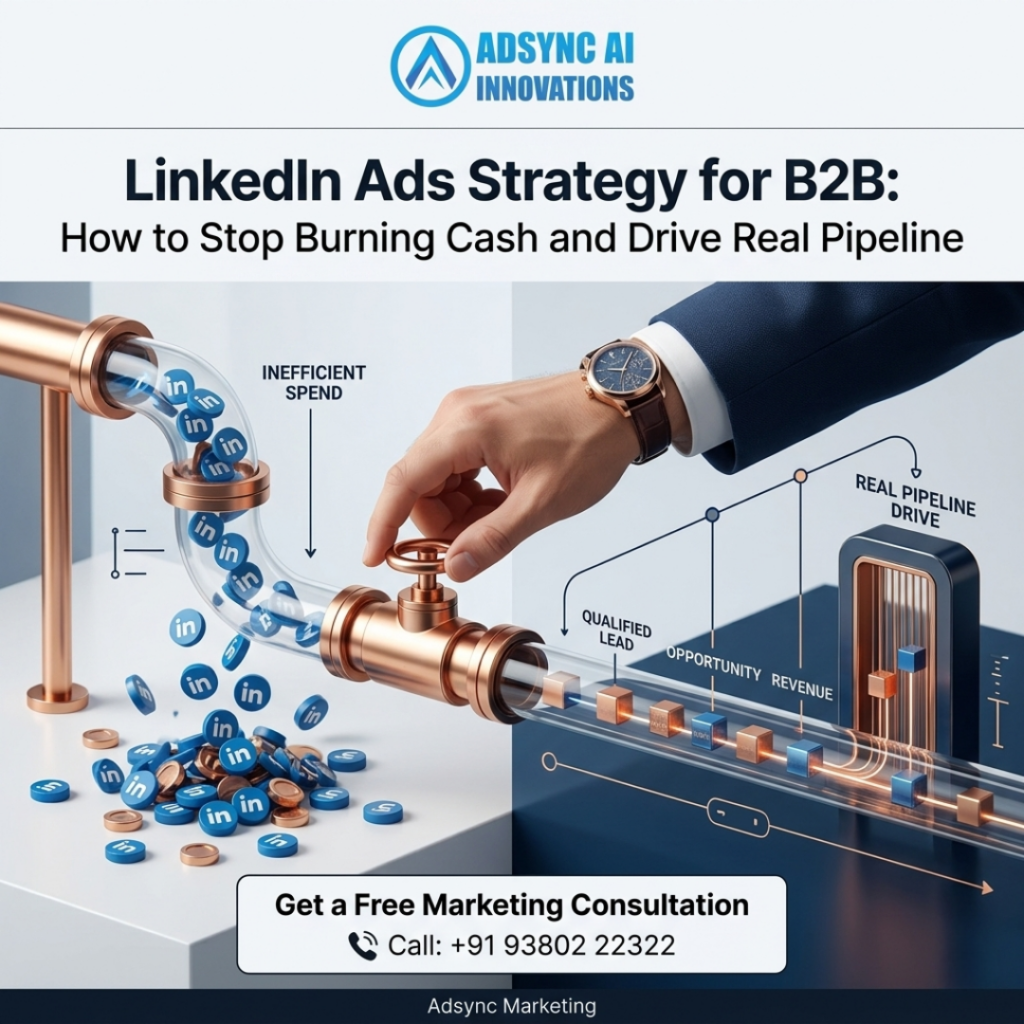
First, if you work in B2B marketing, you have almost certainly had a complicated relationship with LinkedIn Ads.
Here is the exact scenario I hear from Indian startup founders and SaaS teams every single week. First, they launch a campaign. Next, they check the dashboard the following day and nearly faint. Specifically, they see a ₹800 Cost Per Click (CPC) and a ₹10,000 Cost Per Lead (CPL). Consequently, they immediately pause the campaign. Finally, they go back to their team and announce, “LinkedIn is too expensive. Let’s stick to Google.”
The truth? LinkedIn remains very expensive. It commands a premium because it serves as the only platform where you can specifically target the “VP of IT” at companies with “more than 500 employees” in “Bangalore.”
However, if you treat LinkedIn exactly like Facebook, you will fail. For example, throwing up a generic corporate graphic and asking cold audiences to “Buy Now” burns your budget in hours. Ultimately, you will have zero pipeline to show for it.
Therefore, if you want to reach decision-makers who actually possess purchasing power, keep reading. Here is the LinkedIn ads strategy for B2B that actively drives profitable growth in 2026.
TL;DR: The Quick Takeaways
- Thought Leader Ads: First, people buy from people. Use employee profiles to run ads instead of faceless company pages.
- Laser Targeting: Second, use Account-Based Marketing (ABM) to target specific companies instead of broad industries.
- Native Lead Gen: Furthermore, keep users on the platform. Native lead forms double conversion rates instantly.
- CRM Integration: Finally, judge success by closed pipeline revenue, not just the initial Cost Per Lead (CPL).
1. Leverage Thought Leader Ads (The 2026 Secret Weapon)
Here is a hard truth about B2B marketing. Nobody wants to hear from your brand. Buyers simply do not trust corporate logos; instead, they trust real people.
Recently, LinkedIn introduced “Thought Leader Ads.” Consequently, they are fundamentally changing how B2B companies acquire leads. Instead of running an ad from your company page, this format changes the game entirely. Specifically, it allows you to put ad spend behind a post from an individual employee’s profile. You can boost a post from your CEO, your Head of Product, or your Lead Engineer.
The post looks exactly like an organic, human update in the feed. It only features a tiny “Promoted by [Company]” tag.
Why it works: For example, your founder might share a post about a specific mistake they made while scaling the business. Next, they introduce your software as the perfect solution. Consequently, this builds immediate credibility. Our data shows that Thought Leader Ads consistently generate higher engagement. Furthermore, they yield significantly lower CPCs than traditional company page ads because they do not feel like a sales pitch.
2. Stop Guessing, Start Targeting
LinkedIn’s targeting remains its ultimate superpower. However, most marketers misuse it by making their audiences too broad or too narrow.
First, if your audience size exceeds 2 million people, you waste money on unqualified clicks. Conversely, if it drops under 20,000 people, the algorithm will struggle to deliver your ads. Your frequency will skyrocket, and you will annoy your prospects. Therefore, a healthy B2B audience size on LinkedIn sits between 50,000 and 300,000 professionals.
The Best Targeting Methods:
- Job Title + Seniority: Instead of targeting the broad interest of “Software Engineering,” target exact titles. Specifically, choose “Chief Technology Officer” or “VP of Engineering.”
- Company List Uploads (Account-Based Marketing): Suppose you have a wishlist of 500 companies in India you want to sell to. You can simply upload a CSV file of those exact company names. Consequently, LinkedIn will only show your ads to decision-makers working inside those specific buildings. This ensures absolutely zero wasted spend.
3. Match Your Offer to the Funnel
The biggest mistake B2B companies make involves asking for marriage on the first date.
A CFO is not going to click a LinkedIn ad and immediately buy a ₹2,00,000 enterprise software package. Ultimately, the B2B sales cycle is long. Therefore, your ad strategy must reflect that reality.
- Top of Funnel (Cold Audience): First, offer pure value. Promote an industry report, a cheat sheet, or an educational webinar. Your primary goal is to capture their email address and prove your expertise.
- Middle of Funnel (Retargeting): Once they download your report, retarget them immediately. Show them a case study or a short video demonstrating exactly how your product solves a problem.
- Bottom of Funnel (High Intent): Finally, they know who you are and trust your brand. Now, you can serve an ad offering a “Free 14-Day Trial” or a “Book a Demo” call.
4. Prioritize Lead Gen Forms Over Landing Pages
Suppose you run a campaign to capture emails or demo requests. Sending mobile traffic away from LinkedIn to your website remains highly risky. If your site takes four seconds to load, the user will bounce instantly.
Instead, use LinkedIn’s native Lead Gen Forms. When a user clicks your ad, a form pops up directly inside the LinkedIn app. The best part? The form comes pre-filled with the user’s exact LinkedIn data (Name, Verified Business Email, Job Title, and Company).
Because the user does not have to type anything out, the friction disappears completely. Consequently, the conversion rate on native Lead Gen Forms is almost always double or triple that of a standard external landing page.
5. Integrate Your CRM for Revenue Attribution
If you evaluate your LinkedIn ads strategy solely based on Cost Per Lead (CPL), you are looking at the wrong math entirely.
For instance, a lead from Meta might cost ₹500. Meanwhile, a lead from LinkedIn might cost ₹2,500. Naturally, a novice marketer will turn off LinkedIn immediately. However, you must connect your CRM (like HubSpot or Salesforce) to the LinkedIn Campaign Manager. By doing so, you can track those exact leads all the way to closed revenue.
Often, you will find that the cheap Meta leads never answer the phone. In contrast, the expensive LinkedIn leads actually convert into high-ticket, long-term contracts. Therefore, always optimize your campaigns based on Cost Per Acquired Customer (CAC) and Pipeline Value. Never judge campaigns just on the initial cost of an email address.
Common LinkedIn B2B Mistakes to Avoid
Before you launch your next campaign, ensure you avoid these predictable traps:
- Using Heavy Text in Images: LinkedIn acts as a professional network, but it remains a social feed. People scroll fast. If your ad graphic features five paragraphs of tiny text, nobody will read it. Instead, use a bold, simple headline on the image.
- Ignoring Exclusions: Always exclude your competitors, your current employees, and your existing customers from cold outreach campaigns. Ultimately, you do not want to pay for clicks from people who already work for you.
- Turning Campaigns Off Too Early: B2B sales cycles take months. If you run a campaign for five days, see no closed deals, and turn it off, you misunderstand how B2B buyers operate. Give your campaigns at least 30 days to build the pipeline.
Build a Predictable B2B Pipeline
LinkedIn advertising is not a platform for experimentation without a solid plan. Because the clicks remain expensive, every single piece of your campaign must be flawless. You must perfect everything from the Thought Leader Ad copy to the backend CRM tracking.
However, when executed correctly, it represents the most reliable engine for driving high-value B2B pipeline.
If you want to capture the attention of decision-makers but lack the time to master LinkedIn’s complex bidding algorithms, we can help. As an AI-driven branding and performance marketing agency in Bangalore, Adsync specializes in building data-backed B2B marketing funnels. We do not chase cheap, unqualified clicks. Instead, we build campaigns designed exclusively to generate serious revenue.
Ready to make LinkedIn work for your business? Reach out to the team at Adsync today, and let’s discuss your growth strategy.
- Call us: +91 93802 22322
- Email us: info@adsyncmarketing.com
- Visit: https://adsyncmarketing.com/