
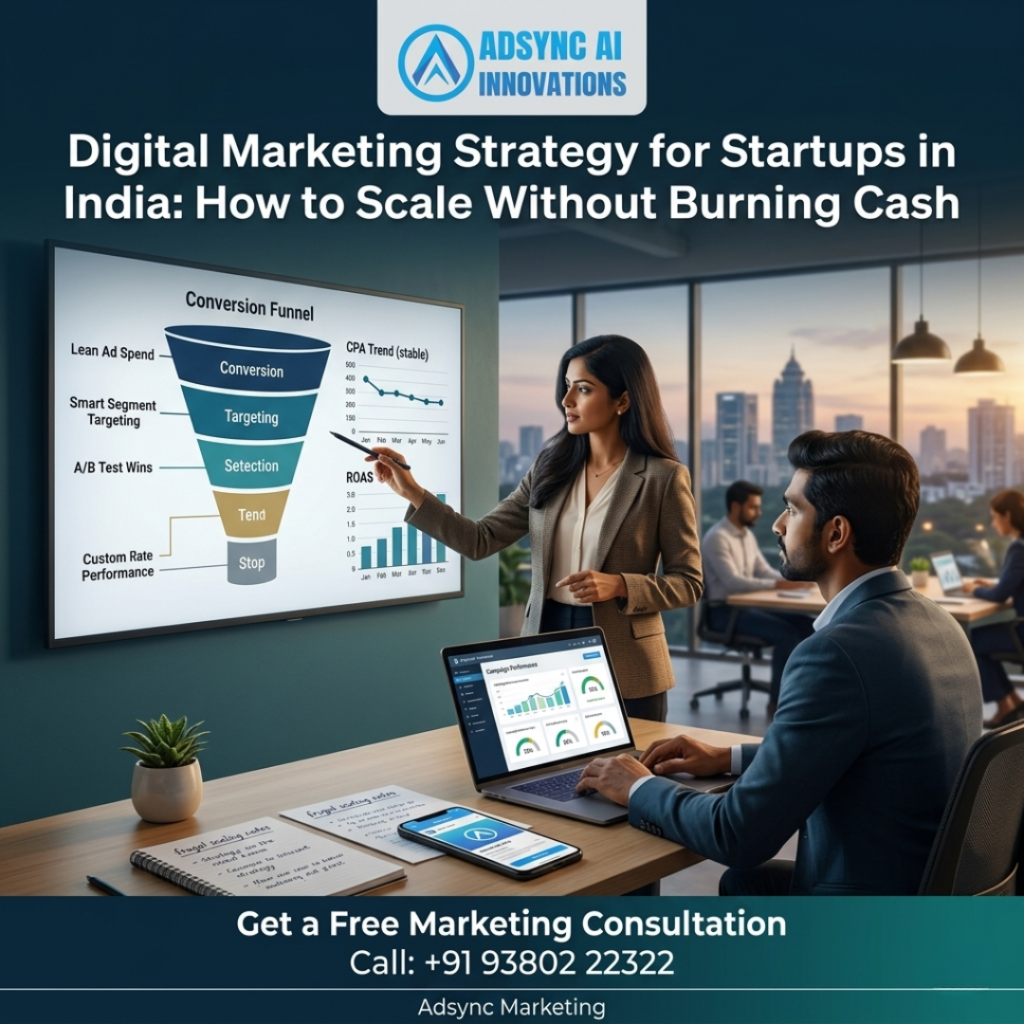
First, if you are a startup founder in India, you operate in an exciting yet highly unforgiving business environment.
Whether you just raised a seed round or actively bootstrap your way to profitability, the immense pressure to show traction never stops. You possess a limited runway and an incredibly tight budget. Furthermore, your board of advisors constantly asks about your customer acquisition costs.
When founders look for marketing advice, they usually receive a massive list of fifty things they “must” do. For example, gurus tell them to launch a podcast, start a YouTube channel, run Google Ads, and go viral on Instagram simultaneously.
However, trying to be everywhere at once represents the absolute fastest way to run out of money completely.
Ultimately, a successful digital marketing strategy for startups in India isn’t about doing everything. Instead, it is about doing the exact right things in the correct order. Here is a practical, phased approach to building a digital growth strategy that generates cash flow today while building a highly sustainable brand for tomorrow.
TL;DR: The Quick Takeaways
- The One Channel Rule: First, never spread your budget across five platforms. Master one single channel completely before expanding.
- Short-Term Survival: Second, use performance marketing immediately to generate cash flow and validate your product.
- The Long-Term Moat: Furthermore, invest heavily in SEO and founder-led content to secure free, highly qualified organic traffic later.
- WhatsApp is Mandatory: Finally, maximize customer retention and lifetime value by using aggressive WhatsApp automation.
The “One Channel” Rule for Early-Stage Startups
Before we break down the specific phases, we must firmly establish the most important rule for startup marketing. Specifically, do not spread your budget too thin.
If you have ₹50,000 to spend this month, splitting it across five different platforms guarantees complete failure. You will never gather enough data on any single platform to know if it actually works.
Instead, pick one primary customer acquisition channel. If you run a D2C e-commerce brand, that might be Instagram Ads. Conversely, if you run a B2B SaaS startup, it might be LinkedIn outreach or Google Search Ads.
Therefore, pour your entire budget and focus strictly into that single channel. Wait patiently until you figure out how to acquire a customer profitably. Only when that first channel runs smoothly should you expand to a second platform.
Phase 1: Fix the Foundation (Before You Spend a Rupee)
You absolutely cannot pour water into a leaky bucket. Therefore, before you spend any money on ads or content, your digital infrastructure must be completely flawless. In the Indian market, this means two very specific things:
- Mobile-First Everything: First, over 80% of your traffic will originate from cheap smartphones on varying network speeds. If your mobile site takes more than three seconds to load, potential customers will bounce before they even see your product.
- Frictionless Payments: Second, if you run an e-commerce startup, your checkout process must be completely localized. If you lack a seamless UPI integration, or if your “Cash on Delivery” (COD) process remains buggy, your conversion rate will plummet instantly.
Phase 2: Short-Term Survival (Performance Marketing)
Startups desperately need cash flow and data quickly. You simply cannot wait six months for an SEO strategy to kick in when you have payroll to meet next week.
Consequently, this is exactly where performance marketing comes in. Paid ads allow you to buy targeted traffic instantly, test your messaging, and validate your core product.
- For High-Intent Products: Suppose you sell something people actively search for, like “emergency plumbing in Bangalore.” In this case, start heavily with Google Search Ads. You place your solution directly in front of people actively looking to buy right now.
- For Visual or Impulse Products: Conversely, suppose you sell something people didn’t know they needed until they saw it. In this case, start with Meta Ads (Facebook and Instagram). Use short, user-generated video content to explain the product and drive immediate impulse purchases.
Ultimately, your main goal in Phase 2 involves figuring out your Cost Per Acquisition (CPA). Exactly how much does it cost to get one person to buy your product? Once that number sits comfortably lower than your profit margin, you possess a highly scalable business model.
Phase 3: Building a Long-Term Moat (Organic & SEO)
Paid advertising remains fantastic for incredibly fast growth. However, it operates entirely as a rental model. The moment you stop paying Google or Meta, your sales drop straight to zero. Furthermore, ad costs inevitably rise every single year.
Therefore, once your performance marketing generates steady cash flow, you must start building organic assets. Ultimately, this represents your long-term moat.
- Search Engine Optimization (SEO): First, start writing deep, educational content answering the exact questions your customers ask. SEO takes time. However, it eventually brings in high-quality traffic for free. Consequently, this drastically lowers your overall blended CPA.
- Founder-Led Social Media: Furthermore, in 2026, people buy from people. Corporate logos remain incredibly boring. Therefore, founders should remain highly active on LinkedIn or X (Twitter). Share the behind-the-scenes journey of building the startup. This builds massive trust and often attracts high-value B2B leads that paid ads simply cannot buy.
Phase 4: Maximizing Lifetime Value (Retention)
Acquiring a brand new customer in India remains highly expensive. Therefore, if a customer buys from you once and never returns, building a profitable startup becomes incredibly hard. You desperately need a robust retention strategy to maximize Customer Lifetime Value (LTV).
- WhatsApp Marketing: First, this remains completely non-negotiable for Indian startups. Email open rates currently sit around 15%. However, WhatsApp open rates consistently exceed 80%. Therefore, use the WhatsApp Business API to send order updates, abandoned cart reminders, and exclusive VIP discounts.
- Post-Purchase Experience: Finally, marketing absolutely does not stop when the credit card is swiped. How you seamlessly onboard a SaaS user dictates whether they will refer you to their colleagues. Ultimately, a great product remains the absolute best marketing strategy in the world.
Practical Examples of Startup Marketing
How does this actually look in practice? Here are two highly distinct paths.
Example 1: A B2B SaaS Startup in Bangalore They build HR software for mid-sized Indian companies. They do not need thousands of clicks; instead, they need 10 excellent leads a month.
Strategy: First, they focus entirely on Google Search Ads targeting high-intent keywords. They send that specific traffic to a landing page offering a free personalized demo. Simultaneously, the founder posts twice a week on LinkedIn about workplace culture. Consequently, this slowly builds a powerful organic audience of HR directors.
Example 2: A D2C Snack Brand in Mumbai They sell healthy, protein-packed Indian snacks. Therefore, they desperately need high volume and broad brand awareness.
Strategy: First, they ignore Google Search completely. They put 100% of their budget into Instagram Reels ads featuring fitness influencers tasting the snacks. When a user buys a trial pack, the system immediately adds them to an automated WhatsApp sequence. Finally, it offers them a 15% discount to upgrade to a monthly subscription.
The Metrics a Startup Founder Must Know
If you execute a digital marketing strategy, you absolutely cannot get distracted by vanity metrics like Instagram followers. Instead, you only need to rigorously monitor these three numbers:
- Customer Acquisition Cost (CAC): The total marketing spend strictly required to acquire one new paying customer.
- Lifetime Value (LTV): The total revenue you expect to generate from that customer over their entire relationship with your startup. (Crucially, your LTV needs to be significantly higher than your CAC).
- Payback Period: How many months does it exactly take to earn back the money you spent to acquire that customer? If startups want to maintain positive cash flow, this specific number must remain as low as humanly possible.
Partner with an Agency Built for Scale
Building a startup remains highly chaotic. Trying to manage product development, hiring, and fundraising while also optimizing your Facebook ad bids represents a guaranteed recipe for burnout.
When you finally find product-market fit, you are ready to pour fuel on the fire. Consequently, you need a marketing partner who deeply understands startup economics.
If you need a digital marketing agency in India that genuinely cares about your burn rate, Adsync is here to help. We operate perfectly as a full-funnel digital marketing agency and performance marketing agency in Bangalore. We absolutely do not sell generic marketing packages. Instead, we build intelligent, AI-driven campaigns explicitly designed to acquire customers profitably and scale your startup predictably.
Ready to build a strategy that actively drives real revenue? Reach out to the team at Adsync today. Let’s discuss your next massive phase of growth.
- Call us: +91 93802 22322
- Email us: info@adsyncmarketing.com
- Visit: https://adsyncmarketing.com/