
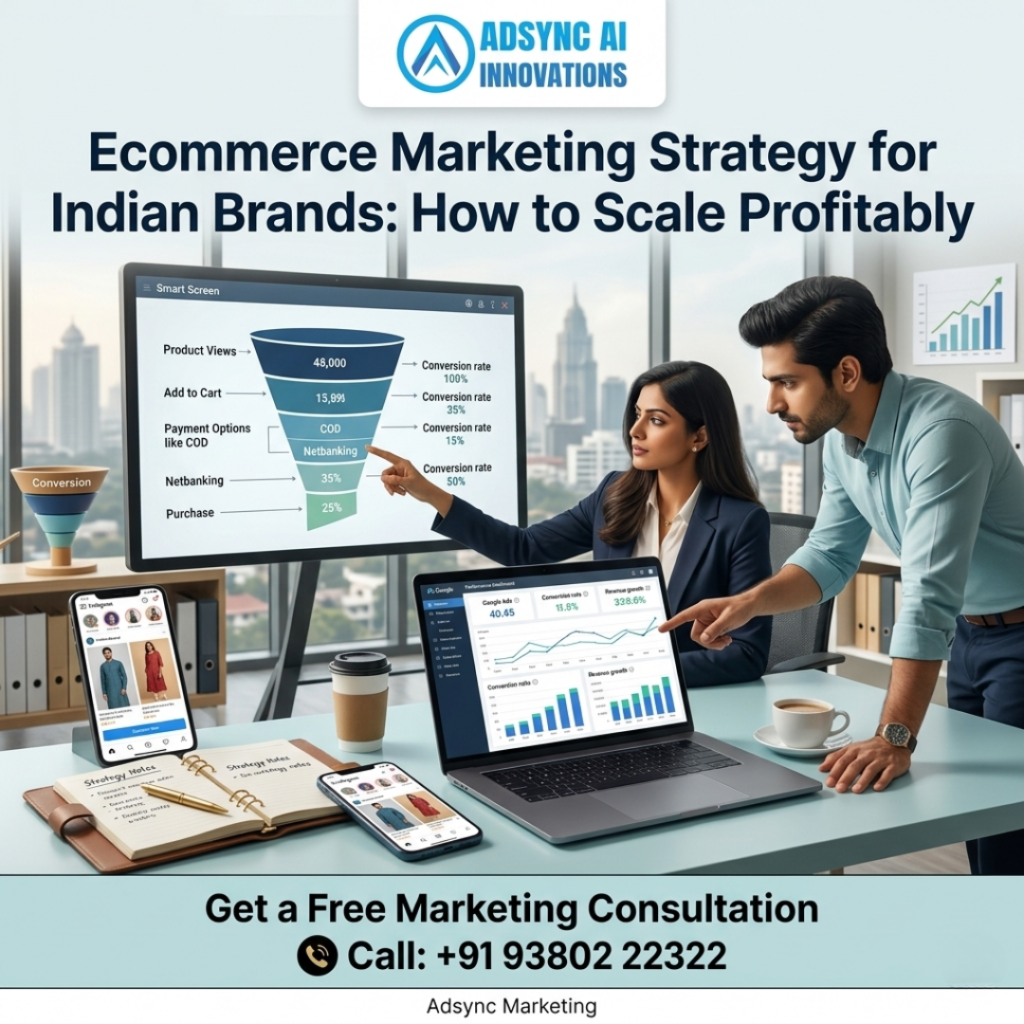
First, setting up an e-commerce store in India has never been easier. You can buy a domain, set up a Shopify theme, and integrate a payment gateway in a single weekend. However, actually getting people to buy your products remains harder than ever.
Currently, the Indian direct-to-consumer (D2C) space feels incredibly crowded. Ad costs on Meta and Google are rising rapidly. Furthermore, logistics costs are squeezing profit margins, and consumer attention spans are constantly shrinking. Therefore, if your entire business plan is simply “run Facebook ads and wait for sales,” you will burn through your capital very quickly.
To survive and scale, you absolutely need a cohesive system. You need a strategy that acquires customers cheaply and keeps them coming back. If you want to move beyond stagnant sales, keep reading. Here is a practical, battle-tested ecommerce marketing strategy for Indian brands.
TL;DR: The Quick Takeaways
- Mobile is Everything: First, over 90% of your traffic comes from smartphones. Therefore, your checkout must be completely flawless.
- Fix the COD Problem: Second, always use WhatsApp to confirm Cash on Delivery orders to drastically reduce expensive RTOs.
- WhatsApp Retention: Furthermore, stop relying solely on email. Use WhatsApp to recover abandoned carts instantly.
- Increase AOV: Finally, if ad costs rise, you must make every individual customer spend more money per order.
1. Master the Mobile-First Checkout Experience
In India, desktop traffic remains practically irrelevant for consumer brands. Specifically, upwards of 90% of your store traffic will originate from mobile devices. If your website is not perfectly optimized for a cheap smartphone on a 4G connection, you lose money instantly.
- Page Speed equals Revenue: First, if your mobile site takes more than three seconds to load, half your visitors will bounce. Therefore, compress your product images. Additionally, remove unnecessary website plugins that unnecessarily slow down the load time.
- Frictionless UPI: Furthermore, Indian consumers demand a seamless UPI experience. If a buyer must manually enter a Virtual Payment Address (VPA), they will abandon the cart immediately. Ensure your payment gateway absolutely offers one-click UPI intent flows.
2. Build a Localized Performance Marketing Funnel
You cannot build a scalable e-commerce brand without paid advertising. However, treating the incredibly diverse Indian market as one single audience represents a massive mistake. You desperately need a funnel that captures attention and converts intent perfectly.
- Top of Funnel (Discovery): First, generate demand via Meta Ads (Instagram and Facebook). People rarely Google for a “turmeric-infused organic face wash” unless they already know about it. Therefore, use fast-paced, bite-sized Instagram Reels to demo your product perfectly.
- Bottom of Funnel (Capture): Once they desire your product, they will search for it. Consequently, use Google Performance Max (PMax) and Google Shopping ads. Capture that high-intent search traffic so your competitors do not steal the sale.
- Go Regional: Finally, if you want to scale into Tier-2 and Tier-3 cities, translate your winning English ads. Test ads in Hindi, Marathi, Tamil, or Kannada. A localized video ad builds trust instantly and inevitably results in a lower Cost Per Acquisition (CPA).
3. Solve the RTO and COD Problem
This specific issue acts as the biggest silent killer for any ecommerce marketing strategy for Indian brands.
Cash on Delivery (COD) remains a necessary evil in India. Many buyers simply do not trust new brands enough to prepay. However, COD orders inherently carry a high Return to Origin (RTO) rate. This means the customer orders the product, but rejects it at the door. Consequently, you lose the sale and still pay the shipping fees.
How to reduce RTO:
- Incentivize Prepaid Orders: First, offer a flat 5% discount or waive the ₹50 shipping fee if the customer prepays via UPI.
- WhatsApp COD Confirmation: Second, never ship a COD order blindly. Send an automated WhatsApp message asking the customer to click “Confirm Order” before shipping. If they do not confirm, simply cancel it. Ultimately, this filters out impulse buyers instantly.
4. Make WhatsApp Your Primary Retention Channel
Email marketing certainly still works. However, in India, WhatsApp reigns as the undisputed king of customer retention. The open rates for WhatsApp messages frequently hit 80%. Meanwhile, email open rates hover around an abysmal 15%.
- Abandoned Cart Recovery: First, if someone abandons their cart, automate a WhatsApp message to go out 30 minutes later. Offer a small discount code to finish the purchase. This simple step alone can quickly recover up to 15% of your lost sales.
- Post-Purchase Upsells: Furthermore, if a customer buys a 30-day supply of vitamins, automate a message for day 25. Ask them how they like the product and offer an immediate restock link.
5. Leverage Raw User-Generated Content (UGC)
Today, consumers have developed massive “ad blindness.” If your Instagram ad looks exactly like an expensive television commercial, people will simply scroll past it. They know you are actively selling to them.
Therefore, to lower your ad costs, lean heavily into User-Generated Content (UGC).
You absolutely do not need massive Bollywood celebrities. Instead, send your product to 50 micro-influencers. Ask them to film an honest, raw review using their smartphone camera. For example, ask them to show the unboxing and explain why they like the product. Finally, use these authentic videos as your primary ad creatives. They blend seamlessly into the feed and convert significantly better than studio graphics.
6. Obsess Over Average Order Value (AOV)
Ad platforms get more expensive every single year. You might not be able to force your CPA below ₹400. Consequently, if your product only sells for ₹500, your profit margin dies completely.
The smartest way to scale profitably involves making every customer spend more money per transaction. You absolutely must increase your Average Order Value (AOV).
- Create Bundles: First, stop selling single t-shirts. Instead, sell a “Summer Wardrobe Pack” of three shirts at a slight discount.
- Free Shipping Thresholds: Second, if your average customer spends ₹600, set a website banner. Say, “Free Shipping on Orders Over ₹999.” Consumers will happily add another ₹400 item to avoid a ₹50 shipping fee.
- Checkout Order Bumps: Finally, right before the customer clicks the payment button, offer a highly relevant, low-cost add-on. For example, if they buy sneakers, offer a ₹199 premium shoe cleaner.
Common Mistakes Indian Ecommerce Brands Make
- Focusing on Revenue Instead of Profit: First, generating ₹10 Lakhs in revenue means nothing if you spent ₹12 Lakhs on ads. Top-line revenue remains completely useless if your unit economics break. Always track your exact profit after ad spend and shipping.
- Running Ads to a Broken Website: Second, never spend money on Facebook ads if your product pages lack customer reviews or feature bad lighting. Ads only bring traffic; ultimately, the website must close the sale.
- Ignoring Existing Customers: Finally, most brands spend 90% of their budget hunting for new customers. They completely ignore people who already bought from them. Remember, selling to an existing customer is five times cheaper than acquiring a new one.
Scale Your Ecommerce Brand Profitably
Building a successful D2C brand in India requires a highly delicate balance. Specifically, it demands aggressive acquisition, strict logistics management, and exceptionally smart retention strategies. When you align your product quality with a data-driven marketing funnel, scaling stops being a gamble. Instead, it becomes a predictable system.
However, managing Meta pixels, configuring WhatsApp automation, and continuously testing ad creatives requires immense dedicated focus.
If you need a partner who deeply understands the exact unit economics of D2C growth, we can help. As a leading performance marketing agency in Bangalore, Adsync specializes in scaling e-commerce brands profitably. We operate as an AI-driven digital marketing agency in India. We combine raw creative strategy with deep data architecture to perfectly lower your CPA and maximize your bottom line.
Ready to stop burning cash and start scaling? Reach out to the team at Adsync today. Let’s build a smarter strategy for your store.
- Call us: +91 93802 22322
- Email us: info@adsyncmarketing.com
- Visit: https://adsyncmarketing.com/