
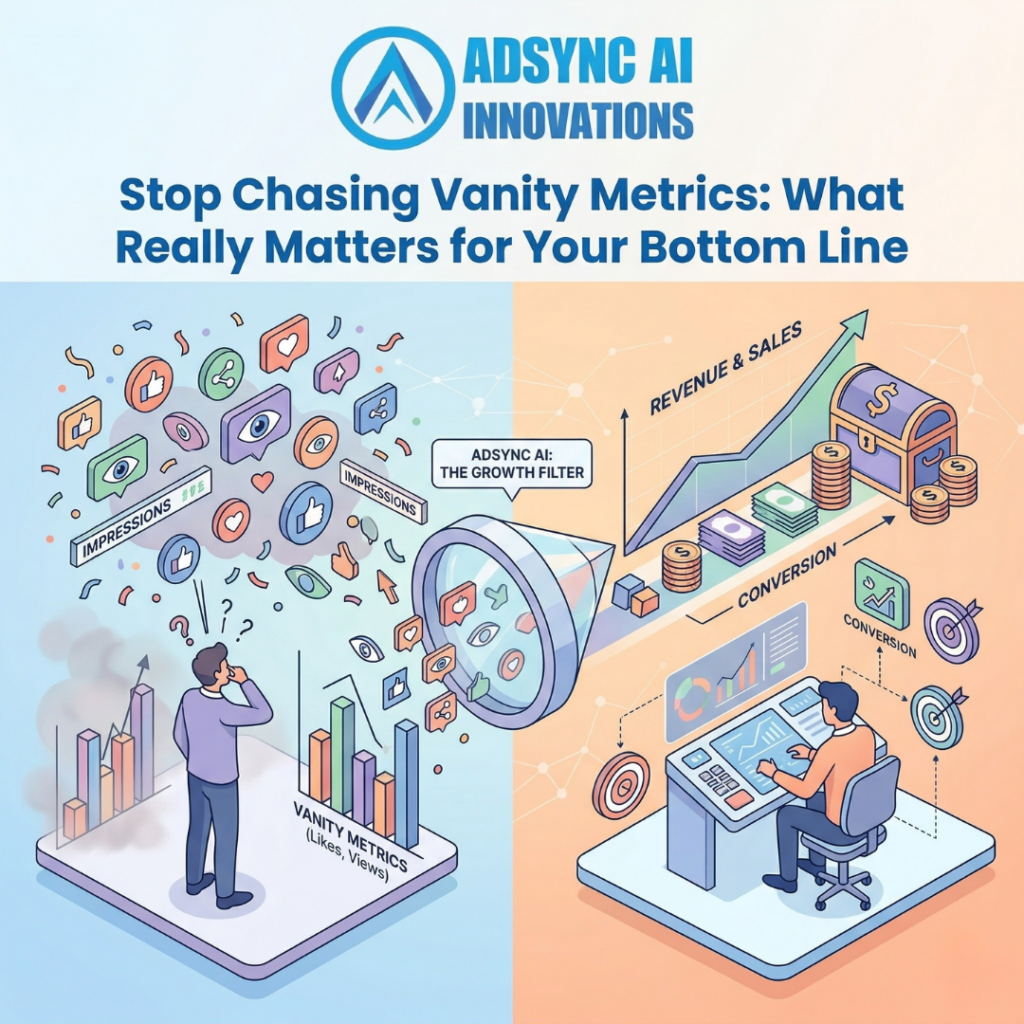
Imagine throwing a massive promotional event for your business. Hundreds of people show up. They eat your free appetisers, compliment the music, take a few selfies, and then go home. When you check the cash register at the end of the night, it is empty.
That is exactly what it feels like to run a digital marketing campaign focused entirely on vanity metrics.
In today’s hyper-connected world, it is incredibly easy to get addicted to the dopamine hit of a “like,” a “share,” or a sudden spike in website traffic. But popularity doesn’t pay the bills. If your marketing reports are full of massive numbers but your revenue is stagnant, you are falling into the vanity metric trap.
Here is a breakdown of the numbers that are lying to you, and the critical metrics you actually need to track to grow your business.
TL;DR: The Quick Takeaways
- Likes Don’t Equal Cash: High follower counts and thousands of likes rarely correlate directly with an increase in sales.
- Focus on Conversion Rate: Traffic is useless if your website visitors aren’t taking a specific, profitable action.
- Know Your Acquisition Cost: You must know exactly how much it costs to acquire one paying customer, or you risk spending your business into the ground.
- Prioritise Lifetime Value: The most profitable businesses focus on keeping their current customers coming back, not just constantly chasing new ones.
1. The Danger of the “Vanity Metric” Trap
Vanity metrics are the numbers that look fantastic on paper and stroke our egos, but do not actually move the needle for your business. We are talking about metrics like:
- Thousands of Instagram likes on a meme that has nothing to do with your product.
- A massive spike in website traffic from an irrelevant viral video.
- A bloated email subscriber list full of people who haven’t opened your emails in two years.
Why are these dangerous? Because they give you a false sense of security. You might think your marketing team is crushing it because your follower count went up by 20% this month. But if those followers are completely unqualified to buy your services, you have just wasted your marketing budget on an illusion.
The Action Step: Do an audit of your current monthly marketing report. Cross out any metric that cannot be directly tied to a lead, a conversation, or a sale. What are you left with?
2. Metric to Track: Conversion Rate
Getting 10,000 people to visit your website is a great start, but it means absolutely nothing if 10,000 people hit the “back” button 30 seconds later.
Your Conversion Rate tells you the percentage of visitors who actually take the action you want them to take. That action could be filling out a contact form, downloading a pricing guide, booking a consultation, or completing a checkout process.
A website with 500 highly targeted visitors and a 10% conversion rate (50 new leads) is infinitely more valuable than a website with 10,000 random visitors and a 0.1% conversion rate (10 leads).
The Action Step: Stop pouring money into ads to drive traffic. Instead, invest in optimising your landing pages. Make your “Call to Action” buttons obvious, simplify your checkout process, and ensure your website builds immediate trust.
3. Metric to Track: Customer Acquisition Cost (CAC)
How much money does it take for you to get one person to buy your product or sign a contract? This is your Customer Acquisition Cost (CAC).
If you are selling a pair of shoes for $100, but you are spending $120 on Facebook Ads and SEO to get one person to buy them, your marketing strategy is literally bankrupting you—even if your ads are getting thousands of clicks.
The Action Step: Calculate your CAC. Take your total marketing and sales expenses for a specific period (ad spend, agency fees, software costs) and divide them by the number of new customers acquired in that same period. If that number is higher than your profit margin, it is time to restructure your campaigns immediately.
4. Metric to Track: Customer Lifetime Value (CLV)
Too many businesses treat marketing as a one-night stand. They spend all their energy acquiring a new customer, making the sale, and then completely ignore them.
Customer Lifetime Value (CLV) measures the total amount of money a customer is expected to spend with your business over the course of your entire relationship. It is almost always cheaper to retain an existing customer than to find a new one. If you can increase your CLV by upselling, offering subscriptions, or providing incredible ongoing support, you can afford to spend more to acquire them in the first place.
The Action Step: Build a post-purchase marketing strategy. Set up automated email sequences that check in on past clients, offer exclusive loyalty discounts, or ask for referrals. Turn your one-time buyers into lifelong brand advocates.
Stop Doing Marketing for Your Ego
The shift from vanity metrics to ROI-focused marketing is a difficult transition for many business owners. It requires you to look at the hard truth of your numbers. It means admitting that a viral TikTok dance didn’t actually help your B2B software company grow.
But once you align your marketing goals with your actual business goals, everything changes. You stop wasting money on fluff, and you start investing in strategies that put money in the bank.
Ready to stop chasing likes and start driving revenue? The team at Adsync Marketing builds data-driven campaigns focused exclusively on your bottom line. Reach out today for a strategy that actually converts.
- Call us: +91 93802 22322
- Email us: info@adsyncmarketing.com
- Visit: https://adsyncmarketing.com/