
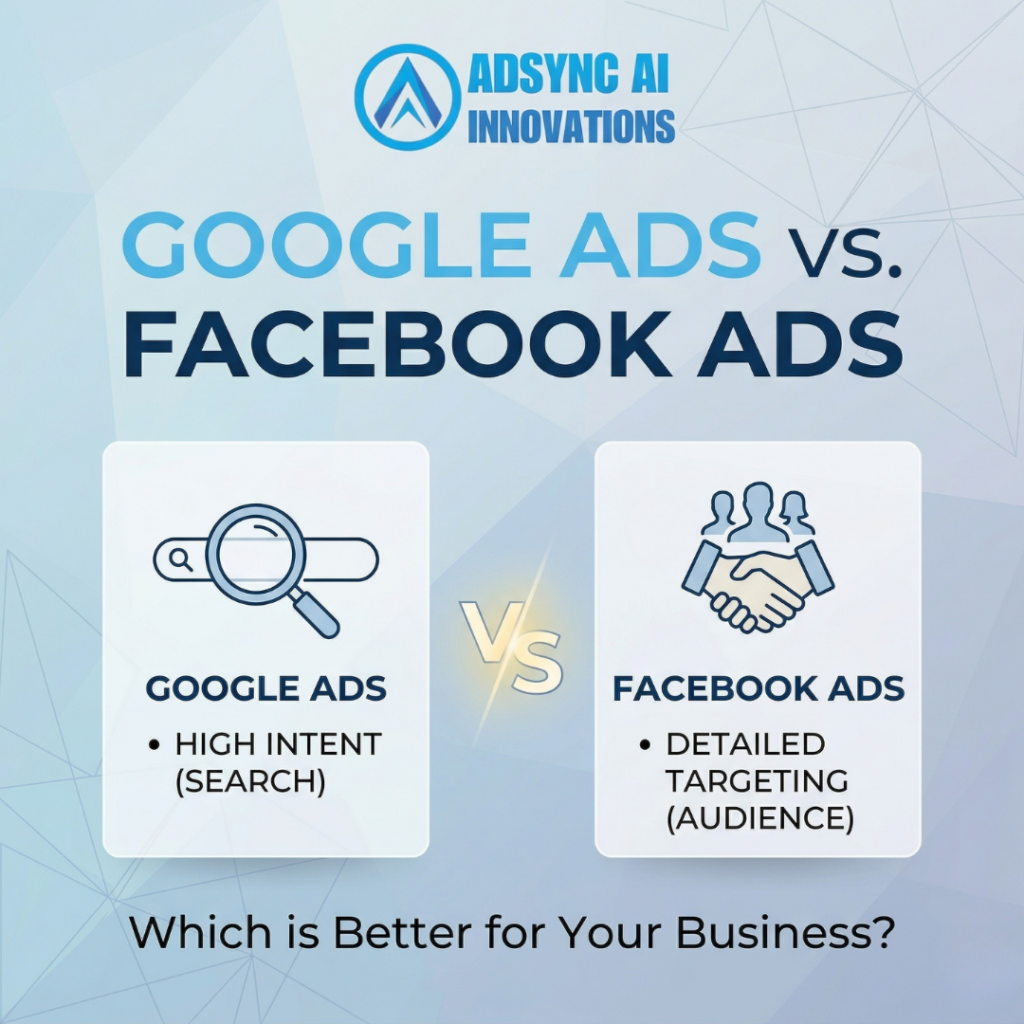
It is the most common debate in digital marketing. You have a marketing budget ready to go, you want to acquire new customers, and you are staring at the two biggest advertising giants on the internet: Google and Meta (Facebook/Instagram).
If you ask five different marketers which platform is better, you will likely get five different answers. Some will swear that Google Ads are the only way to drive serious revenue, while others will claim that Facebook Ads offer the best return on investment in the world.
So, who is right?
The truth is, neither platform is universally “better.” Comparing Google and Facebook is like comparing a hammer to a screwdriver—they are both incredibly powerful tools, but they are designed to do two completely different jobs. Choosing the wrong one for your specific business model is the fastest way to drain your advertising budget.
Here is exactly how to determine which platform will actually make your business money.
TL;DR: The Quick Takeaways
- Google is for Demand Fulfillment: You use Google to capture people who are actively searching for exactly what you sell right now.
- Facebook is for Demand Generation: You use Facebook to introduce people to a product or service they didn’t even know they wanted yet.
- Search Intent vs. Visual Interruption: Google relies on text-based search queries, while Facebook relies on visually stopping users from scrolling past.
- The Ultimate Strategy Uses Both: The most profitable brands use Facebook to build awareness and Google to capture the sale when the customer is finally ready to buy.
1. Google Ads: The Power of High Intent
Think about your own behavior. When the pipe under your kitchen sink bursts and is actively flooding your house, what do you do? You don’t scroll through Instagram hoping to see an ad for a plumber. You go straight to Google and type: “Emergency plumber near me.”
This is the superpower of Google Ads (specifically the Search Network). It captures High Commercial Intent.
When someone types a query into Google, they are already looking for a solution to their problem. They are at the very bottom of the buying funnel. Because these leads are so hot and ready to buy, Google Ads generally have a much higher Conversion Rate than social media ads.
When to Choose Google Ads:
- You sell a service that solves an immediate problem (e.g., home repairs, legal services, IT support).
- Your product fulfills a specific, well-known need (e.g., B2B software, specific auto parts).
- You want high-quality leads that require very little convincing to close.
The Catch: Because the leads are so high-quality, the Cost Per Click (CPC) on Google is often much more expensive. You are entering a bidding war with every other business trying to capture that same searcher.
2. Facebook Ads: The Power of Visual Interruption
Now, let’s look at the other side of the coin. Nobody goes to Facebook or Instagram to buy a new mattress. They go there to look at photos of their friends, watch funny videos, and kill time.
Advertising on Facebook is essentially digital billboard marketing. It is Interruption Marketing. Your job is to put an image or video in front of them that is so visually compelling, it forces them to stop scrolling and pay attention to something they weren’t even looking for.
While Google fulfills existing demand, Facebook creates demand. It allows you to target users based on their deepest interests, demographics, and behaviors.
When to Choose Facebook Ads:
- You have a highly visual product (e.g., clothing, innovative fitness gadgets, beautiful home decor).
- You are launching a brand new product that people don’t know exists yet (you can’t search Google for something you don’t know about).
- You want to build brand awareness and grow a community at a much lower Cost Per Click than Google.
The Catch: Because users aren’t actively looking to buy when they are on social media, the Conversion Rate is generally lower. You have to work much harder to convince them to pull out their credit card.
3. The Retargeting Goldmine
If you want to see your Return on Ad Spend (ROAS) skyrocket, the secret isn’t choosing one platform over the other; it is making them work together through retargeting.
Let’s say you run an e-commerce store. A user searches Google for “best running shoes,” clicks your Google Ad, browses your website, but leaves without buying because they got distracted.
If you stop there, you lose the sale. But if you have a Facebook tracking pixel installed on your site, you can now show that exact user a highly visual Facebook ad featuring the exact pair of shoes they were just looking at, perhaps with a 10% discount code. You used Google to capture their initial intent, and Facebook to follow up and close the deal.
Stop Guessing With Your Ad Budget
Throwing money at an advertising platform without a clear understanding of intent versus interruption is a recipe for disaster. Before you launch your next campaign, you must align your platform choice with how your customers actually behave.
Not sure where your advertising budget will generate the highest ROI? Stop gambling with your ad spend. The team at Adsync Marketing builds data-driven ad strategies across both Search and Social to ensure every Rupee you spend comes back with friends.
- Call us: +91 93802 22322
- Email us: info@adsyncmarketing.com
- Visit: https://adsyncmarketing.com/