
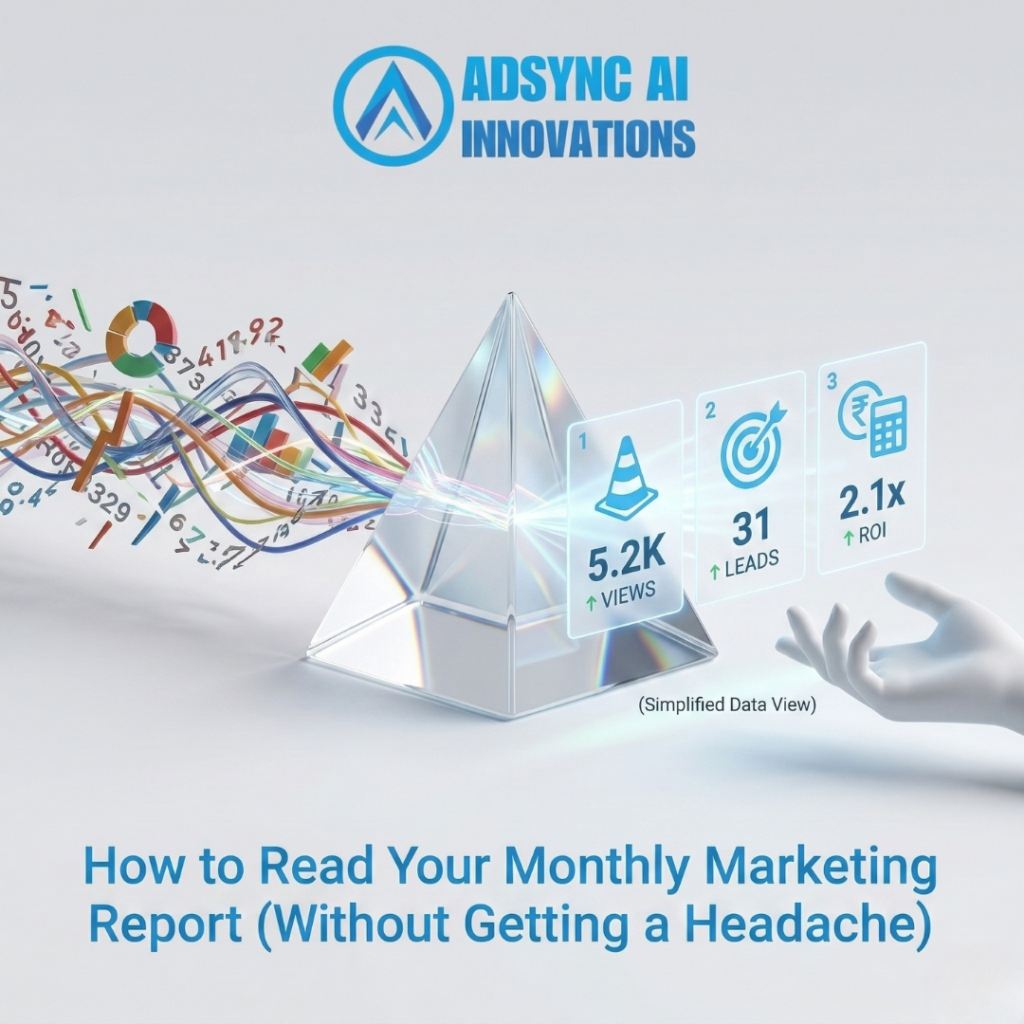
It is the 5th of the month. An email pings in your inbox from your digital marketing agency with the subject line: Monthly Performance Report.
You open it up, and you are immediately hit with a 30-page PDF filled with pie charts, line graphs, and a dense alphabet soup of acronyms—CPC, CTR, CPL, ROAS. You scroll to the bottom, try to figure out if you actually made any money, give up, and close the tab.
If this sounds familiar, you are not alone.
Many marketing agencies use complex data to confuse their clients intentionally. They overwhelm you with “impressions” and “reach,” so you won’t realize that your actual sales haven’t moved an inch. As a business owner, you shouldn’t need a master’s degree in data analytics to understand if your marketing investment is working.
Here is a straightforward, no-nonsense guide to translating your monthly marketing report and identifying the metrics that actually impact your bottom line.
TL;DR: The Quick Takeaways
- Ignore the Fluff: Impressions and Reach just mean your ad was on a screen; it doesn’t mean anyone actually cared or clicked.
- Context is Everything: A drop in traffic isn’t always bad if your quality of traffic (and conversion rate) goes up.
- Focus on the “Cost Per”: Knowing exactly how much it costs to acquire a lead or a customer is the most important math in your business.
- Demand the “So What?”: Data without an action plan is useless. Your report should tell you exactly what the agency is doing next to improve.
1. The Acronym Translation Guide
Before we look at the charts, let’s translate the jargon. Here are the four metrics you actually need to care about:
- CTR (Click-Through Rate): Out of everyone who saw your ad or search result, how many actually clicked it? If 100 people saw your ad for corporate tax filing, and 5 people clicked, your CTR is 5%. A low CTR means your ad copy or image is boring.
- Conversion Rate: Out of everyone who visited your website, how many took an action (called you, filled out a form, bought a product)? A low conversion rate means your website is confusing or your offer is weak.
- CPL (Cost Per Lead): How much ad spend did it take to get one person’s contact information? If you spent ₹5,000 on Google Ads and got 10 phone calls, your CPL is ₹500.
- CAC (Customer Acquisition Cost): How much total marketing spend did it take to get one paying customer?
The Action Step: When you open your next report, skip the first few pages of “traffic overviews” and look directly for your CPL and CAC. Those two numbers dictate your profitability.
2. Spotting the “Vanity Metric” Trap
Agencies love to brag about “Impressions.” An impression simply means your ad loaded on someone’s screen. If they were scrolling past it at 100 miles an hour, it still counts as an impression.
Imagine you run a specialized kidney hospital. Your agency reports that your latest Facebook campaign reached 100,000 people. That sounds incredible! But if those 100,000 people were teenagers who don’t need your specialized medical care, that metric is completely useless.
The Action Step: Ask your agency to stop reporting on reach and impressions as a primary KPI (Key Performance Indicator). Instead, ask them to report strictly on booked consultations, inbound phone calls, or qualified form submissions.
3. Understanding Month-over-Month (MoM) vs. Year-over-Year (YoY)
Data needs context. If your website traffic dropped by 20% from November to December, panic might set in.
However, if you own a company that manufactures and sells school backpacks, a drop in December is completely normal—your peak season is back-to-school in June and July. Comparing December to November (MoM) is going to look terrible. Comparing this December to last December (YoY) gives you the real picture of whether your brand is growing.
The Action Step: Always look at the historical context. Ask your marketing team to include YoY comparisons in your reports so you aren’t making rash decisions based on normal seasonal fluctuations.
4. Demand the “So What?” Summary
Data is just numbers on a page. The real value of a marketing agency is the analysis of that data.
If your report shows that your Cost Per Click for your international sea shipping campaign went up from ₹40 to ₹85 this month, your agency shouldn’t just hand you the chart and say, “Here is the data.” They should be providing a written summary that says:
“Our CPC doubled this month because a massive competitor entered the ad auction. So what are we doing about it? Next month, we are shifting 30% of the budget away from these expensive keywords and reallocating it to a highly targeted LinkedIn campaign aimed directly at supply chain executives.”
The Action Step: If your monthly report does not include an executive summary explaining why the numbers look the way they do and what the strategy is for next month, send it back and ask for an explanation.
Stop Settling for Confusing Reports
You are the CEO of your business, not a data scientist. You deserve a marketing partner who speaks plain English, focuses on your actual revenue, and treats your marketing budget with the same respect you do.
Are you tired of paying for 30-page reports that don’t make any sense? At Adsync Marketing, we believe in radical transparency. We build custom, easy-to-read dashboards focused entirely on the metrics that make your business money.
- Call us: +91 93802 22322
- Email us: info@adsyncmarketing.com
- Visit: https://adsyncmarketing.com/