
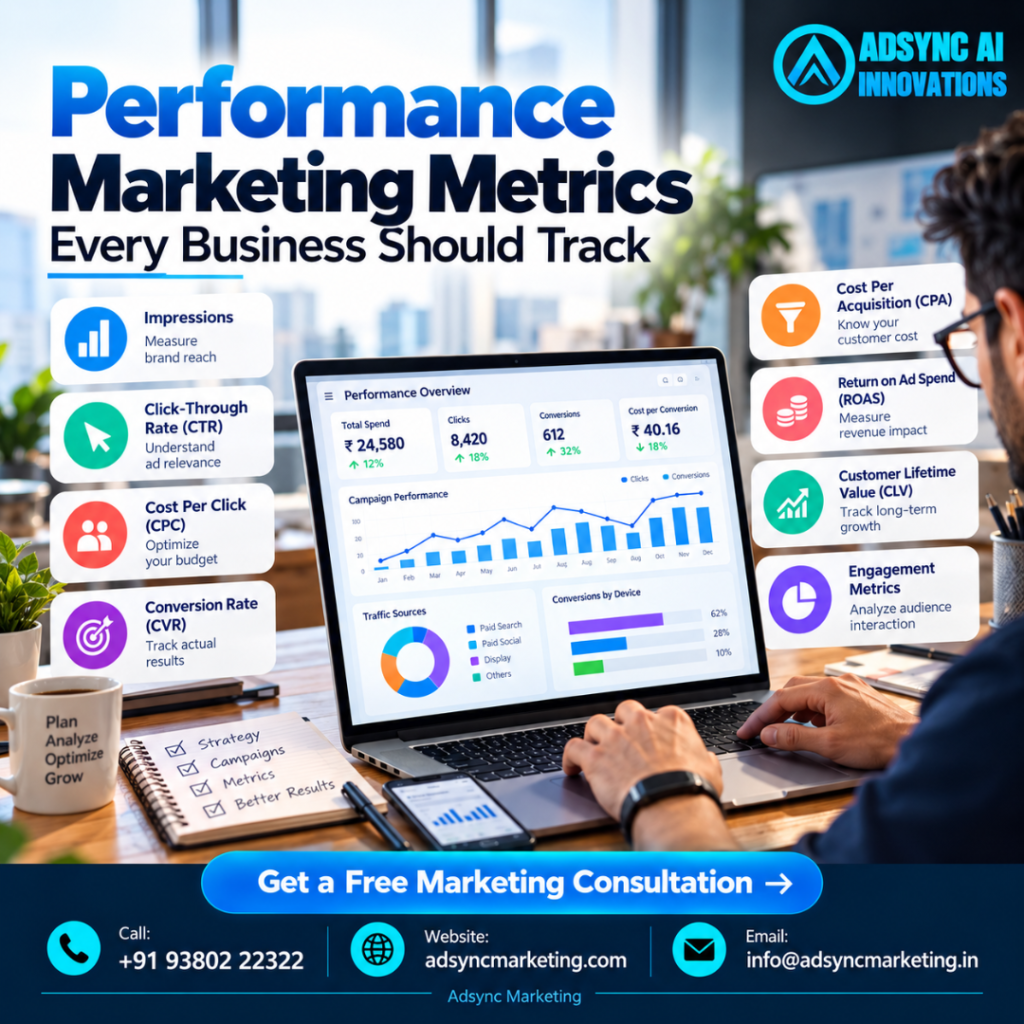
Digital advertising can generate clicks and visitors, but this doesn’t necessarily mean marketing efforts are effective. It’s important to analyze which metrics link advertising efforts to key business outcomes.
This is why tracking the right metrics is important for effective performance marketing.
All types of businesses, from startups to large enterprises, should implement performance marketing and measure it against predefined goals.The measurement could include metrics such as Cost per Acquisition (CPA), Return on Ad Spend (ROAS), conversion rates, and analysis of campaigns.
For businesses in Bangalore and across India, performance marketing, combined with use of artificial intelligence (AI) and automation, could transform their business and provide positive growth.
What Is Performance Marketing?
Performance marketing is a form of digital marketing in which the goal is to measure marketing efforts in terms of specific business outcomes or actions.
These outcomes may include:
– Leads
– Sales
– App installs
– Phone calls
– Form fills
– Bookings
– Sign-ups
These actions may vary based on the campaign and business outcomes. The purpose of each campaign should be to further business goals.
A performance marketing strategy, by definition, should start with measuring key business outcomes or actions. Thus, businesses should define key business outcomes and associated metrics before launching campaigns.
Why Performance Marketing Metrics Matter
There are several hundred metrics available in various marketing platforms. The real challenge is to understand which metrics merit focus.
Measuring the right marketing metrics helps businesses:
- Improve campaign efficiency
- Identify best performing channels
- Avoid waste in advertising
- Refine audience targeting
- Compare campaigns
- Evaluate creative
- Make better marketing budget trade-offs
- Pinpoint conversion issues
- Improve ROI on marketing spend
For small businesses and startups, measuring marketing spend is essential. Small businesses typically do not have the marketing budgets of big businesses, so small businesses need to measure and track their spending to ensure they are generating the best possible return on their marketing dollars.
Here are 10 essential performance marketing metrics you should be tracking.
1. What is Cost Per Click (CPC)?
Cost per Click (CPC) is the average cost for each click on an advertisement.
It is important to understand that just because the cost per click is high, it doesn’t mean that the marketing campaign is wasteful. If a marketing campaign has an expensive CPC, but that campaign drives a lot of high quality customers to the business, it doesn’t mean that campaign is inefficient or a waste of money.
Conversely, a low CPC can mean that the campaign is driving traffic of little to no value to the business.
2. Click Through Rate (CTR)
The Click through Rate (CTR) is the percentage of people who clicked an advertisement out of the total number of people who viewed the ad.
The ad could have a high CTR, but that doesn’t mean the campaign was successful. The ad could have generated a lot of clicks, but very few of those clicks resulted in customers. Marketing campaigns should be measured by a number of different metrics.
Evaluate conversion rate when assessing landing pages, offers, website experience, and campaign quality.
2. Cost Per Click (CPC)
CPC is the average cost for an advertisement click.
The most common formula is:
CPC = Total Clicks ÷ Total Cost
Some advertisers accept a high CPC to gain first-mover advantage.
3. Cost Per Mile (CPM)
CPM is the cost for 1,000 advertisement impressions.
Since CPM is commonly used with display advertising, it is most relevant for advertisers using this method.
4. Cost Per Acquisition (CPA)
CPA is the cost for customer acquisition or conversion.
CPA varies for different industries. A business providing a high-value service, for example, may charge a high CPA.
5. Return On Ad Spend (ROAS)
ROAS is the ratio of revenue to advertising cost.
In the example where a campaign generated a revenue of ₹2,00,000 for an advertising cost of ₹50,000, the ROAS would be 4.
When comparing the efficiency of campaigns, ROAS can be useful; however, the profit of a business is not determined by ROAS.
6. Cost Per Lead (CPL)
CPL is the cost to generate a lead.
B2B, real estate and other service businesses should focus on CPL.
7. Customer Acquisition Cost (CAC)
CAC is the overall cost for customer acquisition.
A CAC can be different from a CPA at a platform level as the CAC may incorporate several marketing and acquisition costs.
1. Customer Acquisition Cost (CAC)
This is the total cost to acquire a customer over a specific time period.
Total cost is a function of sales and marketing spend for a given time period.
CAC is useful for businesses to evaluate the economics of acquiring a customer.
8. Lead-to-Customer Rate
Getting leads is only part of the process.
The other part is converting leads to customers.
This metric helps marketing and sales teams determine the quality of campaigns and leads, as well as whether the price and product are aligned with customer needs, among others.
9. Customer Lifetime Value (CLV)
This metric is customer value over the lifetime of the relationship with the business.
CLV helps a business think about the customer acquisition cost in the long-term.
A campaign with a high up-front cost to acquire a customer may still be good for the business if the customer is highly valuable and long-lasting.
10. Campaign Analytics and Attribution
This part brings together several data sources to understand the customer journey.
A business should answer where are website visitors coming from, what campaigns are driving conversions, how do users engage with a web page after clicking on it, and why are potential customers leaving the website.
Because of the complex customer journey, attribution should be a inform a business decision and not represent every customer interaction.
How to Build a Performance Marketing Measurement Process
A practical measurement process can be divided into six steps.
The Business Goal is Defined
Which of the following do you want your campaign to accomplish: Generate Sales? Leads? Enquiries? Awareness? Registrations? Bookings? Other?
The Primary Metrics are Chosen
Choose a handful of metrics associated with the goal.
Tracking is Configured
Set up the necessary analytics, conversions, events, UTM parameters, integrations with CRM, and platform measurement.
Benchmarks are Set
Look at historic data or look at relevant data for the business to set benchmarks.
Campaign Performance is Analyzed
Take a look at how the campaign is performing based on audience, creative, keyword, placement, location, device, and other dimensions.
Campaigns are Tested and Optimized
Use data to drive decisions on what to test next. This can be anything from the offer to the landing page, budget to campaign structure, or audience to location targeting.
Which Marketers Need this?
Small Businesses
Small businesses can use the data to see if they are using their limited ad dollars efficiently.
Startups
Startups need data to help them determine their customer acquisition costs, and help test and discover which audiences and channels are working best.
Growing Businesses
As a business grows and ads are running across multiple platforms, data helps give a holistic view of marketing performance.
Marketing Teams
Metric consistency helps the marketing team communicate data and marketing performance to other stakeholders in the business.
Aspiring Performance Marketers
Aside from book knowledge, having hands on experience with performance marketing gives insight into analytics, attribution, conversion, and cost metrics which can help get a job in the performance marketing industry.
Common Mistakes when Measuring Performance Marketing
Accurately measuring performance marketing can be tricky. There are many tricks marketers use that can make campaigns appear to be stronger or weaker than they are.
- Ignoring Clicks and Impressions
- Mismanaging Conversions
- Ignores Lead Quality
- Comparing Different Campaigns
- Making Decisions from Very Limited Data
- Modifying Campaigns too Frequently
- Ignores Landing Page Experience
- Profit is not the Same as ROAS
- Measuring Marketing and Sales Independently
- Using too many Metrics and Ignoring Priorities
- Determining the Right Metrics depends on several Factors like:
- Business Model
- Campaign Objectives
- Industry
- Budget
- Competition
- Customer Journey
- Time and Timeline
Why is AI-Driven Performance Marketing Important?
For performance marketing Bangalore businesses, AI is able to join up paid marketing with other digital services. For example AI is able to connect paid marketing campaign data to:
- CRM Data
- Marketing Automation
- AI Chatbots
- Website and Customer Analytics
- Lead Management
This can improve the way Marketing and Sales Teams work together.
While some think that AI could lessen the need for human judgment, others suggest that it will allow marketing professionals to spend less time on repetitive data processing and more time on critical tasks including business strategy, experiments, creative processes and critical decision-making.
Why choose AdSync AI Innovations?
We are a performance marketing agency that leverages AI, automation, and digital strategy to help our clients.
Our approach is different in that it is designed around real world, measurable objectives as opposed to marketing activities aimed at making something up to do.
We give our clients the opportunity to explore performance marketing and paid media solutions as well as AI marketing automation, web design, and text and voice chatbots.
We also provide digital and AI strategy, consulting and intelligent automation software solutions. We also teach AI and offer related work experience and placements.
If you are looking for performance marketing Bangalore solutions, our focus is on understanding your business goal, choosing the right metric for the job, and using the right technology to improve our digital growth process.
Frequently Asked Questions
1. What are the most important performance marketing metrics?
CPA, ROAS, conversion rate, CPL, CAC, CTR, CPC, lead-to-customer rate, and customer lifetime value are among the commonly used metrics. The most important metrics depend on the campaign objective.
2. What does CPA mean in performance marketing?
CPA means Cost Per Acquisition. It represents the average cost of generating a defined acquisition or conversion. Businesses should evaluate CPA alongside customer value and lead quality.
3. What is a good ROAS?
There is no universal ROAS benchmark that works for every business. A suitable target depends on margins, operating costs, customer lifetime value, industry, competition, and business objectives.
4. Why is conversion rate important?
Conversion rate shows how effectively website visitors or other users complete a desired action. It can help businesses evaluate campaign quality, landing pages, offers, and customer experience.
5. Can AI improve campaign analytics?
Yes. AI can assist with analyzing large datasets, identifying patterns, automating reports, detecting changes, and supporting optimization. Human review remains important when interpreting results and making strategic decisions.
AdSync AI Innovations
579, 32 D Cross, 10th Main Rd, Jayanagar, Bengaluru, Karnataka 560011
Phone: +91 93802 22322
Email: info@adsyncmarketing.in