
Introduction
The field of search optimization is rapidly evolving. AI is affecting how businesses perform keyword research, create content, analyze audiences and competitors, and ultimately optimize for search. With AI gaining more traction, how will search optimization be impacted in the coming years?
This creates an opportunity and a challenge for businesses that are searching for AI SEO solutions in Bangalore. While the core concepts of search optimization remain the same, there is increased emphasis on how AI-powered user interfaces interpret questions, and how business can leverage AI to create content summarization and answer evidence.
A fully optimized search presence requires intelligent technology and content, as well as understanding of how search optimization works and user intent. This means incorporating AI-powered tools and technology, content and technical SEO, and integrating various components to be successful.
Given the goal is to use AI to make SEO smarter and more useful for people, traditional search optimization practices should be kept in mind.
What Is AI SEO?
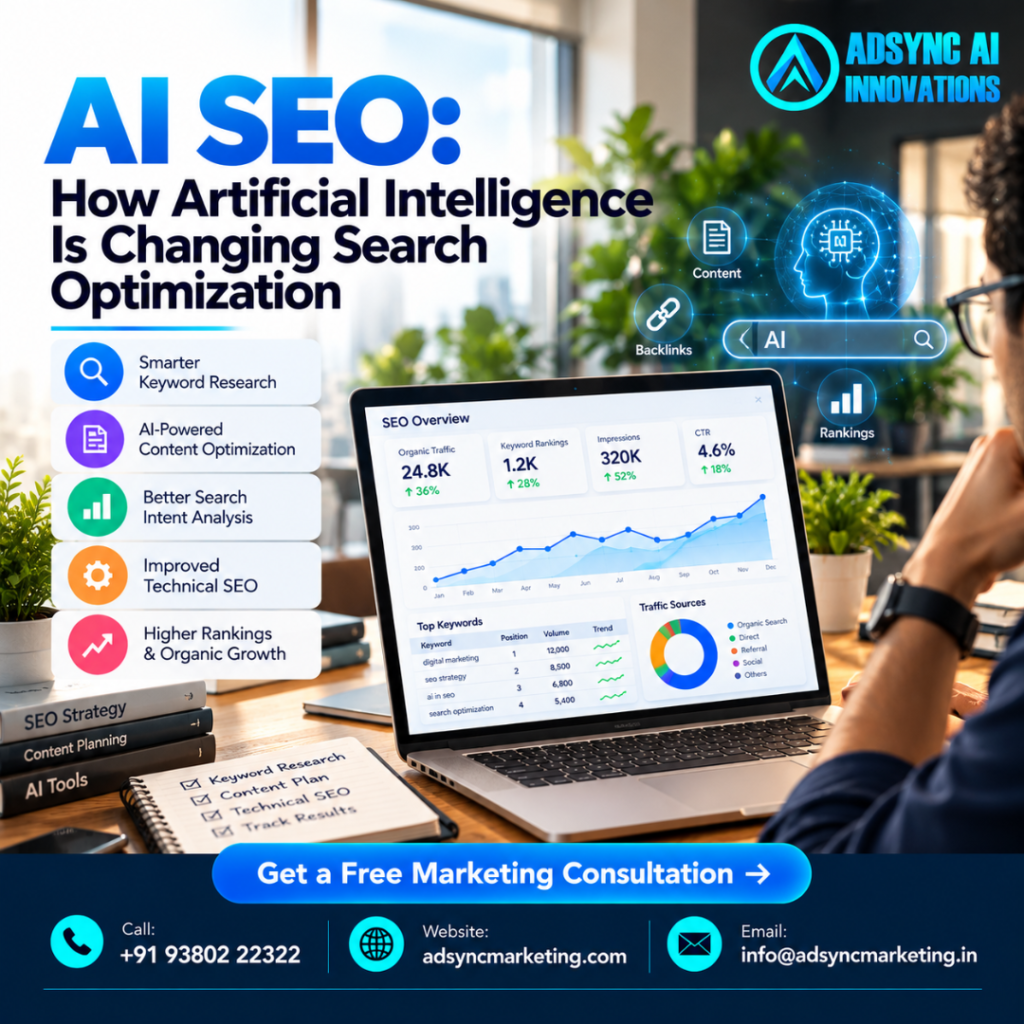
AI SEO is a catch-all phrase used to describe how various AI and machine learning tools are integrated and used to enhance and automate different activities in search optimization. Some of the processes that are generally impacted by AI SEO tools include:
- Keyword research and search-intent analysis
- Competitor and SERP analysis
- Content strategy and planning
- Content creation and optimization
- Tech SEO and site architecture
Other processes that are generally affected by AI SEO tools include performance and ranking analysis and reporting.
According to Google, creating high-quality, helpful content that is reliable and people-first is the focus. Generative AI can be useful in some ways, but producing a large quantity of low-value content to manipulate search results can cross over into Google’s spam policies.
According to Google, the key elements of quality content remain the same. However, there are a few fundamental changes in the world of SEO.
1. Search has become more conversational. So, people have turned to asking longer questions. Users are searching for longer, more detailed questions.
How can digital marketers begin to answer these questions to assist search engines in better results?
– Create topic clusters
– Create content around user questions
– Analyze different search themes
– Answer existing customer questions
– Identify opportunities in search intent
– Identify gaps in competitor topics
– Analyze existing content and create a plan for improvement
AI and other assistive technology can provide the answers; it is important that human evaluators vet the suggestions to ensure the recommendations align to business objectives, customer needs, search data, and overall expertise.
Lastly, content creation is beginning to utilize AI to identify structure opportunities, missing topics, and other ways to answer user questions.
The goal is to have content written in a way that is more helpful and meaningful to the reader, not content so packed with keywords that it is overwhelming to the reader.
AI Search is Changing Visibility
Traditionally, search has been dominated by a list of blue links.
With the increased integration of AI across various services, users may be able to interact with different pieces of information using different AI models and search features offered by Google.
In recent guidance, Google said existing SEO fundamentals remain important for visibility in generative search experiences. This indicates that businesses need to focus on:
– Quality, useful content (both text and multimedia)
– Technical SEO
– Trustworthy business information
– Good website structure and navigation
AI search systems are extremely useful, but the goal is not to get your content to be so useful that it tricks AI search systems. Instead, focus on making your content so useful that AI search systems understand, reference, and trust it.
AI in SEO and SEO Automation
The greatest advantage of AI in the field of workflow automation is SEO automation. This provides the opportunity for marketing teams to focus more on high level strategy and creative work as opposed to repetitive tasks and mundane work.
AI in SEO can be used to automate the following tasks:
-Create content
-Identify data and content gaps
-Optimize content
-Generate workflows to organize topics and keywords
-Flag pages for review
-Modify and evaluate site content after a page has been published
-Track site performance after a site update
Google clearly states it does not like scaled content created to manipulate search rankings, regardless of whether humans, artificial intelligence (AI), or a combination of the two are used to generate the content.
Google for Developers
Who Needs AI SEO?
AI-powered search optimization has a lot of potential use cases across a variety of different organizations.
For Small Businesses
Local businesses can use AI-generated content to answer customer questions and create effective local content.
This can be beneficial for small businesses in Bangalore when trying to compete with businesses located closer to customers for location-based searches and answer customer questions for more specific and long-tail searches.
For Startups
AI can be beneficial to small teams for different marketing automation tasks and research for marketing and content planning.
For Growing Brands
AI can be beneficial for larger businesses to optimize content at scale for large and growing websites, and analyze different areas of a business and identify opportunities for improvement.
For Marketing Teams
AI can help marketing teams work with more aligned data and create more integrated digital marketing strategies.
For Students and Professionals
Knowledge of AI SEO can help differentiate candidates for various digital marketing and other related jobs.
Learning SEO in conjunction with AI tools, analytics and content can help professionals forge more useful and practical digital marketing skills.
A Practical AI SEO Process
A practical AI SEO strategy can contain a structured and repeating set of steps.
To create effective SEO strategies, you first need to define a business’s goals. What is the goal? Is it to increase the number of enquiries, improve local search visibility, build authority, boost a service, sustain an e commerce category, or inform a prospect about a product?
Next, we define the target audience. Who are the buyers? What are their concerns? When do they buy? What are the things they want to know? How do they search?
Use research tools to find what the consumers are searching for and group them based on their intent. (i.e. do, know, buy, go, etc.)
Always write content that is informative and useful based on what the customers are really interested in, supported by data and evidence.
Write and edit content to ensure site optimization.
Pay attention to on-page elements of SEO. Aim to cover all aspects of SEO.
The goal of content creation is to educate the consumer about the service or product a business offers. Use meaningful data to improve site performance. Useful content should target the most interested customers of a business. The focus of a business should be on the customers. Useful content should improve the performance of a site. Improve site performance by eliminating irrelevant data. Remember to tailor content to each stage of the buyer’s journey. Optimizing site performance using SEO is an ongoing process. Repetitive keywords in SEO content can look unnatural. SEO should be used strategically to help the business meet its goal of attracting more customers.
Common SEO mistakes to avoid
Publishing AIs unedited content
AI can generate content that is incorrect, outdated, or irrelevant.
Ignoring Mass Production
Mass-produced pages, according to Google, raise more questions than answers. How much original content is on the page? Is the content a reasonable amount for the purpose of the page? Is the purpose of the page to fulfill a user’s search query? Mass production may point to a lack of original content and a focus on search visibility above user experience.
Neglecting Mobile
Mobile’s growing importance for search should not be underestimated. In a mobile-first world, performance on mobile should not lag behind. Internationalization and multilingual SEO are also ranking factors.
Attributing Everything to AI
AI and automation tools extend human capabilities, but replace human knowledge and skills? Additionally, an AI model must first learn what a ‘correct’ or ‘wrong’ answer is by analyzing loads of example data. Which example data does the AI model use to come up with an answer? It is easy to praise AI when it matches our expectations or views, but it’s important to seek the reasoning behind AI’s recommendations. Humans should evaluate AI’s recommendations in light of the specific goal and context.
Depending on the SEO strategy and approach, there will always be variation in results. Factors that are outside of your control (the competition and your budget) will always impact the results of a digital marketing campaign. The quality of the product offered and service rendered, the soundness of strategy, and the control exercised over the competing forces will also impact results.
Why Choose AdSync AI Innovations?
AdSync AI Innovations leverages AI in combination with digital strategies and performance marketing. Services include AI-optimization, AI-marketing automation, AI-performance marketing, AI-web design, AI text/voice chatbots, AI software and intelligent systems, AI consulting and strategy.
This comprehensive strategy is beneficial because most contemporary SEO tactics do not operate in a vacuum.
Search visibility can fuse with:
- AI website experiences
- Performance marketing
- Marketing automation
- Chatbots and lead qualification
- Content strategies
- Analytics
- Software and intelligent systems
- Brand and business growth
AdSync also develops learning pathways in AI marketing, generative AI for content and SEO, data analytics, prompt engineering and related technologies.
For students and young professionals, its internship programs offer real world projects and mentorship, as well as industry tools, and skills over teaching classroom theory.
Frequently Asked Questions
1. What is AI SEO?
AI SEO is the use of artificial intelligence to support SEO research, content planning, optimization, technical analysis, automation, and performance monitoring while keeping human strategy and quality control involved.
2. Is AI SEO useful for businesses in Bangalore?
Yes. Businesses in Bangalore can use AI-assisted SEO to understand local search intent, improve content, automate repetitive marketing activities, and build stronger digital visibility. Results depend on competition, industry, website quality, strategy, budget, and implementation.
3. Does AI-generated content rank on Google?
AI-generated content is not automatically rewarded or penalized simply because AI was used. Google emphasizes helpful, reliable, people-first content. AI-generated material that exists primarily to manipulate search rankings or is produced at scale without meaningful value can violate spam policies. Google for Developers+1
4. Can SEO automation replace an SEO professional?
No. Automation can handle repetitive tasks and assist with research and analysis, but strategic decisions, quality control, business understanding, creativity, and expert review remain important.
5. How can I learn AI SEO?
Students and professionals can develop AI SEO skills by learning SEO fundamentals, content strategy, analytics, generative AI tools, prompt engineering, and marketing automation. Practical projects and real-world application can make the learning process more valuable.
AdSync AI Innovations
579, 32 D Cross, 10th Main Rd, Jayanagar, Bengaluru, Karnataka 560011
Phone: +91 93802 22322
Email: info@adsyncmarketing.in