
Introduction
Writing quality content is essential for businesses to thrive; however, producing a constant stream of content is a challenge for many businesses. With the growth of the digital space, marketing teams have to create a variety of content pieces for various platforms (i.e., blogs, social posts, landing pages, emails, ads, product descriptions, and SEO content). Creating all of these pieces can consume a significant amount of time and resources for a marketing team.
Solutions in AI content automation have the potential to make a significant positive impact in this area.
AI content automation uses various aspects of generative AI to create different kinds of content. AI content automation provides companies the ability to automate different aspects of the content creation and workflow process.
The objective of marketing teams and growing brands is to enhance their business in an efficient manner through a system that allows them to produce quality content. This system allows businesses to maintain brand consistency in an accurate manner.
What is AI content automation?
AI content automation is the application of artificial intelligence and/or an automated workflow to various aspects of the content creation and/or content marketing process.
Some aspects of the content creation process include
Keywords, planning, writing, editing, content publication, and/or marketing performance analysis.
AI content automation provides marketers opportunities to complete the above tasks in various ways through intelligent tools. Examples of generative AI tools include content research, briefs, outlines, first drafts, headlines, FAQs, content re purposing (i.e., social posts, videos, graphics, info graphics, etc.), and/or marketing metadata.
Human marketers are crucial for brand voice and oversight. This oversight includes, but is not limited to, fact-checking, making final decisions about content creation and/or marketing strategies, and providing creative direction.
The Challenges of Traditional Content Marketing
Content marketing can easily get out of control when everything starts from scratch.
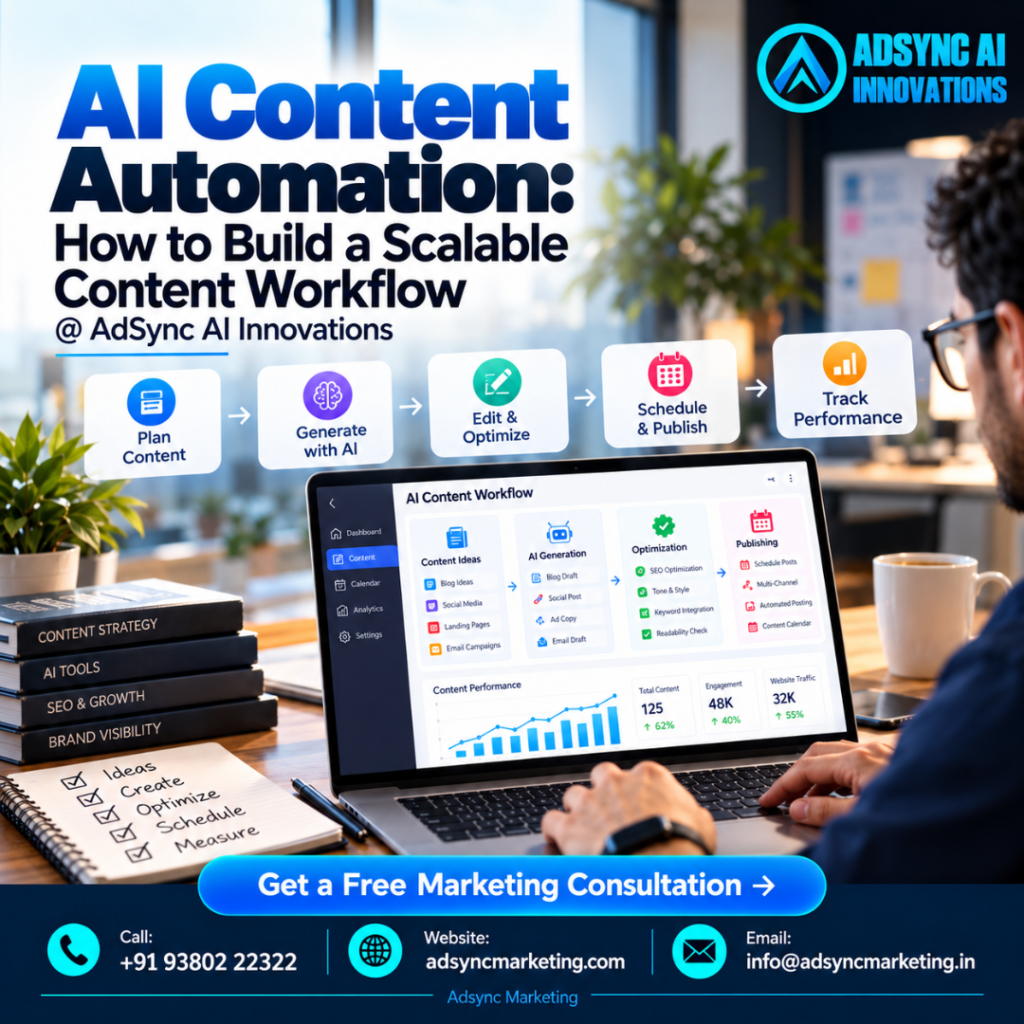
Building a scalable content marketing workflow creates standard processes that the team can follow and improve.
1. More Efficient Content Production
Rather than writing an entire blog from scratch, the AI can generate a draft based on a set of instructions.
The marketer can use their time to be more strategic and creative, such as conducting research to inform content and making improvements based on data.
2. More Consistent Content
A workflow can guide your team on creating content that accurately represents your brand, creates a voice and tone, covers a target audience, leverages an appropriate format, adheres to SEO standards, and outlines approval and publishing processes.
3. More Effective Content Creation
Small marketing teams may have a tough time covering all the content needs of the business across several channels.
Using an AI workflow can help a small team repurposed content into new formats.
4. Better Content Strategy
Rather than making assumptions on content strategy based on limited knowledge of what’s working and what’s not, what questions are customers asking, how are they engaging, what are the trends, and what is the content performance? Why not let the data drive content strategy?
How to Create an AI Content Automation Workflow
You need to determine your business goals and how content can help you achieve those goals. Using the goals, you can decide what kind of content to create and what success looks like.
Step 1: Identify Your Target Audience
Create clear audience segments.
A Bangalore technology company may have founders, marketing managers, small– to medium-sized enterprises (SMEs), students, enterprise decision-makers and technology professionals as their segments.
Being able to identify your target audience’s problems helps you create topic ideas as opposed to generating ideas for AI content creation.
Step 2: Build a Content Strategy
Come up with topics relating to your products, services, and solutions as well as your customers’ problems and the industries you serve.
Your content strategy should include primary and secondary keywords, search intent, topic clusters, formats, frequency, distribution channels, and goals.
This creates an effective automated workflow.
Step 3: Use Generative AI for Production Support
Generative AI can help with research, outlining, drafting, variations, FAQs, social captions,, and content re purposing.
The AI output must be assessed for accuracy and relevance.
The AI should augment, not replace, the production process.
Step 4: Add SEO and Quality Controls
Prior to publication, create a quality control checklist.
Review the title and headings, keyword placement, internal links, and meta descriptions for search intent, user experience, factual accuracy, and calls to action.
This is where the process prevents automation from becoming a shortcut to publish content.
Step 5: Automate Distribution and Re purposing
Once the content is approved, automation can help repurposed and distribute the content.
For example, one detailed blog could become:
– Content for LinkedIn
– Shorter social posts
– Content for email newsletters
– FAQs
– Scripts for videos
– Sales ennoblement content
– Content for the website
By doing this, you get more value from your original content.
Step 6: Measure and Improve
Track meaningful metrics such as:
– Organic traffic
– Engagement
– Content assisted conversions
– Leads
– Ranking
Use the data to further optimize the workflow.
Who Needs AI Content Automation?
AI content automation Bangalore solutions can help:
– Small Businesses
– Start-ups
– Marketing agencies
– Growing Brands
Students, job seekers, and digital marketing professionals can learn how to leverage AI, automation and content for their careers. AdSync has various courses teaching generative AI for Content & SEO, AI marketing strategy, Prompt Engineering and other data science and digital marketing skills.
– Only looking at keywords: Search visibility should support real user value.
– Disregarding brand voice: Automated content should align with brand voice.
– Automating all tasks: Important, strategic decisions should not be automated.
– Not fact-checking: AI may generate incorrect or outdated information.
– Focusing solely on website traffic: Conversion and meaningful customer engagement should be prioritized.
– Using numerous, disjointed tools: Simplifying the workflow with an integrated system can be more efficient.
Importance of AI-Driven Support
AI in marketing can be valuable in uniting the various components of the digital ecosystem.
AI can influence content, SEO, performance marketing, websites, chatbots, CRM processes, analytics, and customer communication.
AdSync AI Innovations specializes in intelligent systems and processes in web design, AI text and voice chatbots, marketing and brand growth, software systems, and AI strategy and business consulting.
Content can support various aspects of the customer journey, from attracting with a blog to using a website to move the customer toward the end goal, to supporting and guiding customer engagement with a chatbot or marketing automation.
What Makes Us Different?
AdSync AI Innovations uses AI technology to drive digital marketing strategies. They use a performance-focused approach to create marketing solutions. They explain their process as using AI insights to craft digital strategies with automation and SEO to provide solutions at scale and achieve measurable business results. AAdsyncMarketing – Adsync Marketing
Relevant services can be found on the AdSync AI and Digital Marketing Services page.
For individuals wanting to develop their skills, AdSync provides an AI focused learning program. Additionally, they offer the Generative AI for Content & SEO pathway which takes an approach of using prompt engineering and AI for SEO and automating content creation. AAdsyncMarketing – Adsync Marketing
The AdSync Tech Accelerator offers an industry exposure internship program focusing on project work, mentorship, using industry tools, and preparing for job interviews. AAdsyncMarketing – Adsync Marketing
To support businesses in their wider integration of AI, the company provides AI and machine learning services and training. AdSync Marketing—AdSync Marketing
Frequently Asked Questions (FAQs)
Q1: What is AI content automation, and how does it help small businesses in Bangalore?
AI content automation uses artificial intelligence to streamline research, drafting, and distribution. For small businesses in Bangalore, it enables consistent publishing across digital channels without requiring expensive, large-scale content teams.
Q2: Does using generative AI for content hurt search engine rankings?
No, provided the content is helpful, original, and reviewed by human editors. Search engines focus on content quality, relevance, and user intent rather than whether AI assisted during creation.
Q3: How do you maintain brand voice while using automated content tools?
Brand voice is preserved by creating custom prompt libraries, feeding clear style parameters into generative AI tools, and enforcing strict human editorial review before publishing.
Q4: Can AI content automation guarantee top rankings or guaranteed leads?
No reliable agency or tool can guarantee specific rankings or lead figures. Results depend on competition, campaign quality, target audience, budget, and consistent long-term execution.
Q5: Does AdSync AI Innovations offer training and internships in AI content marketing?
Yes! AdSync AI Innovations offers specialized courses, internship programs, and career support for students, job seekers, and marketing professionals looking to master AI-driven marketing and automation skills.
AdSync AI Innovations
579, 32 D Cross, 10th Main Rd, Jayanagar, Bengaluru, Karnataka 560011
Phone: +91 93802 22322
Email: info@adsyncmarketing.in