
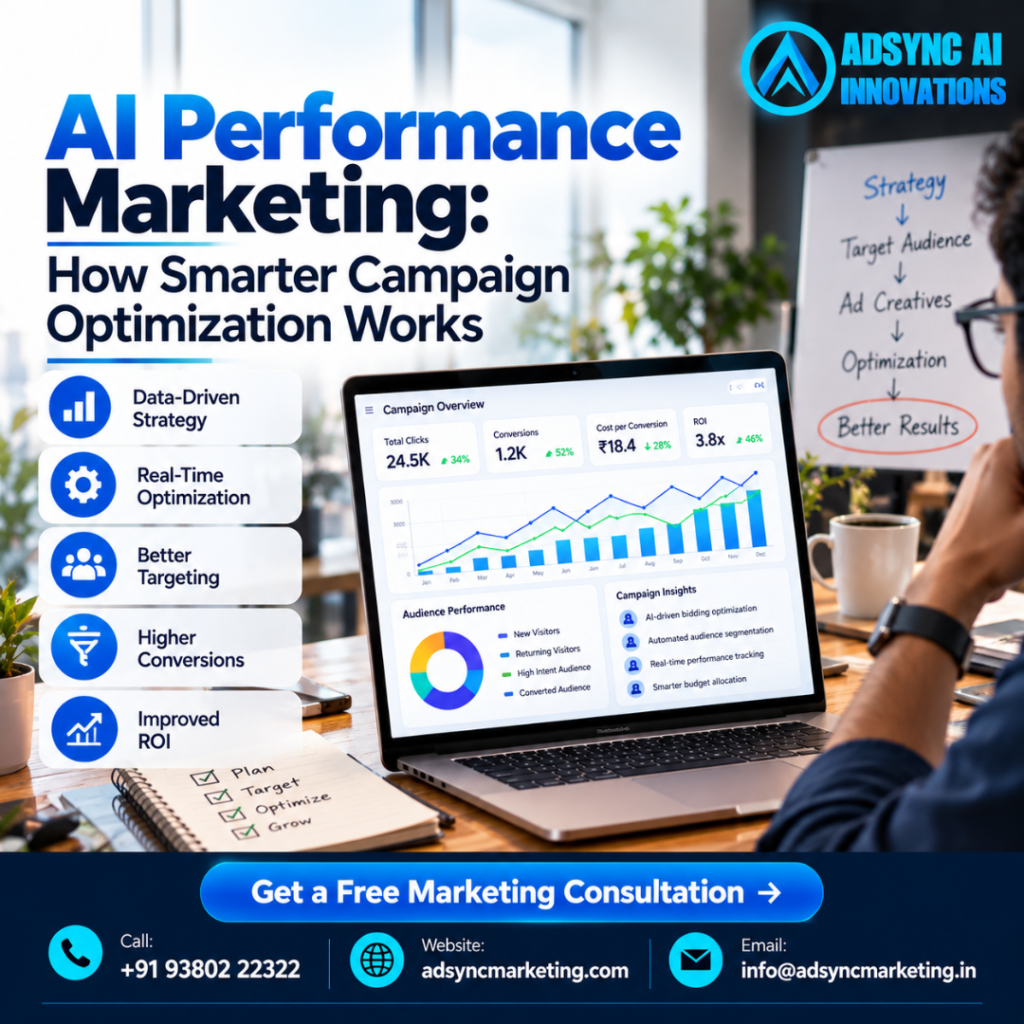
Introduction
There is more advertising data than ever before. However, just because there is more data doesn’t mean marketing decisions become better automatically. Campaigns produce clicks, impressions, leads, and conversions, and behavioral signals across numerous platforms. The main issue is figuring out how to leverage this information quickly.
This is what makes AI performance marketing increasingly relevant for startups, SMEs, large corporations, and growing brands.
AI can help marketing teams uncover patterns, automate tasks, improve audience targeting, monitor campaign performance, and facilitate optimization. AdSync AI Innovations utilizes AI to help performance marketing, automate, analyze, and strategize businesses’ digital spaces.
What is AI performance marketing?
Performance marketing optimizes digital campaigns by leveraging artificial intelligence, integrating different ad platforms, relying on analytical and automated systems, and using conversion data.
Traditional campaign management focuses on manually updating dashboards, audience and creative edits, reviewing keywords, and producing reports.
AI marketing can help achieve the same outcomes at a larger scale. AI can be used to help marketers understand
- Campaign and performance trends
- Audience segmentation
- Creative performance
- Campaign and performance changes
- Marketing workflows and automation
- Optimize bidding and budgets
- Integrate ad and conversion data
- Generate actionable insight
The aim is not to completely replace the marketer. AI can provide information to marketers to help them make decisions.
data the marketing personnel would have access to in the CRM system.
How Smarter Campaign Optimization Works
1. Collecting the Right Marketing Data
Effective optimization starts with reliable data.
Businesses may collect information from advertising platforms, websites, CRM systems, analytics tools, forms, chatbots, and customer journeys.
This data can help marketers understand where prospects are coming from and what happens after someone clicks an advertisement.
Without accurate data, even sophisticated AI systems can produce misleading insights.
2. Understanding Audience Behavior
AI can analyze large volumes of customer and campaign data much faster than manual processes.
For example, marketers can examine patterns involving:
- Audience demographics
- Device behavior
- Geographic locations
- Search intent
- Website engagement
- Previous interactions
- Conversion behavior
These insights can help businesses refine targeting and messaging while avoiding unnecessary assumptions about individual customers.
3. Optimizing AI Ads and Campaigns
AI ads can use automation and machine-learning capabilities available within modern advertising platforms.
Instead of treating every audience or advertisement identically, campaign systems can use performance signals to identify combinations that appear to be working better.
Marketers can then test different:
- Ad creatives
- Headlines
- Offers
- Landing pages
- Audience segments
- Campaign objectives
- Calls to action
Human oversight remains important because campaign performance also depends on factors such as competition, market demand, budget, product quality, and customer experience.
4. Improving Conversion Tracking
Pixels and other forms of tracking can help businesses identify which marketing campaigns are responsible for leads. Unfortunately, not all conversions are easily measurable. A business still needs AI and other automated systems to process, analyze, and make sense of large volumes of customer data.
5. Measuring ROAS and Other Performance Metrics
In performance marketing, return on ad spend (ROAS) measures the return generated by marketing spend.
While marketers look at ROAS, there are other performance metrics worth considering:
Cost per lead
Cost per acquisition
Conversion rate
Click-through rate
Customer acquisition cost
Lead quality
Revenue
Customer lifetime value
The performance metrics of interest vary depending on the goals of the campaign.
Who can Benefit From AI Performance Marketing?
AI performance marketing is applicable to a wide range of organizations.
Startups
New organizations need to efficiently test multiple marketing variables to effectively operate in the market. AI can assist marketing teams in reviewing and processing information derived from campaigns to identify key opportunities for improvement.
Small and Medium-sized Enterprises (SMEs)
AI marketing can help SMEs automate repetitive, mundane marketing tasks to help teams focus on more impactful work like differentiating their products/services, improving customer experience, and sales.
Growing Brands
Brands increasing distribution can use AI to assist them in optimizing their marketing at scale.
Marketing Teams
AI marketing can assist in automating repetitive tasks to give marketing teams more control in strategizing the marketing process.
Students and Employed Individuals
It is useful to learn the basics of AI marketing for students and professionals interested in digital marketing to better comprehend the combination of technologies driving the marketing ecosystem and how to effectively utilize marketing automation.
AdSync provides online marketing courses on AI and other topics.
Step 1: Establish the business goal.
Something measurable like increasing the number of qualified leads, improving online purchases, enhancing the number of appointments scheduled, or improving the visibility of the brand would work here.
Step 2: Review the current data
This includes reviewing the ads account, website analytics, conversion tracking, CRM, and the performance of previous campaigns.
Step 3: Determine opportunities for improvement
This includes reviewing the performance of campaigns, the quality of the audiences targeted, creatives used in the campaigns, landing pages, acquisition costs, and other issues that negatively impact the performance of campaigns.
Step 4: Test hypothesis
This is usually done by structuring a campaign in a certain way and determining which audiences, landing pages, and offers are the most effective and then scaling those.
Step 5: Review campaign performance
While it is easy to determine the performance of a campaign by looking at the number of impressions or clicks, this should not be the end goal. There are other relevant performance metrics that should be reviewed first, and the focus should be on helping the business meet its objectives.
Step 6: Identify changes needed to be made.
Typically, campaign data is used to identify changes needed to be made to a campaign, like pausing, expanding, adjusting, or further testing the campaign.
Step 7: Integrate marketing efforts with automation.
Using AI marketing automation can help integrate the marketing efforts of a business and help with tasks like lead nurturing and management. AI text and voice chatbots can help with lead management and marketing efforts. AdSync helps businesses by providing AI voice and text chatbots as well as marketing automation.
Automation is not enough: Critical judgment is still needed for brand positioning, creative assessment, compliance, and business context.
Blind trust in automated systems: Failure to consider the user experience in the end-to-end marketing process will catch up.
Marketing outcomes are influenced by industry, budget, competition, campaign quality, customer journey, offer, and timeline.
AI Integration will TRANSFORM your business.
The true power of AI is when you integrate it throughout the business to close the data, system, and decision-making gaps.
Here’s an example of what’s possible:
Integrate AI across the marketing funnel to improve lead generation and qualification.
The user journey could look like this:
-Click on an AI-optimized ad.
-Arrive on an AI designed optimized landing page.
-Chat with an AI chatbot.
-Submit a lead capture form.
-Enter an automated workflow.
-Become a sales opportunity.
Integration is especially important for companies focusing on digital growth systems rather than individual ads.
What Makes AdSync AI Innovations Unique?
Positioned at the crossroads of artificial intelligence, digital and automation strategies, software and solutions, and performance marketing, AdSync AI Innovations offers a range of services comprising AI optimization, AI marketing and automation, AI performance marketing, AI website design and development, AI marketing and brand growth, text and voice chatbots, intelligent and automated business systems and software, and AI marketing strategy.
There are numerous course and internship offerings for individuals seeking exposure to artificial intelligence, marketing automation and data analytics, and related technologies. The internship program includes project-based learning, learning and working with industry-standard tools, mentoring, and employment readiness training.
Frequently Asked Questions
1. What is AI performance marketing?
AI performance marketing uses artificial intelligence, advertising data, analytics, automation, and conversion insights to support more informed campaign decisions and optimization.
2. How can AI improve advertising campaigns?
AI can help analyze campaign data, identify patterns, support audience segmentation, automate repetitive processes, and provide insights that marketers can use when testing and optimizing campaigns.
3. Why is conversion tracking important?
Conversion tracking helps businesses understand which marketing activities contribute to meaningful actions such as leads, purchases, calls, appointments, or sign-ups. It provides more useful information than measuring clicks alone.
4. What does ROAS mean in digital marketing?
ROAS means Return on Ad Spend. It is commonly used to compare advertising revenue with advertising expenditure. Businesses should also consider other metrics such as acquisition cost, conversion rate, lead quality, and customer lifetime value.
5. Is AI performance marketing suitable for small businesses?
Yes. Small businesses can use AI-assisted marketing, automation, analytics, and chatbots to streamline workflows and make better use of available marketing data. The appropriate approach depends on the business objective, budget, industry, competition, and customer journey.
AdSync AI Innovations
579, 32 D Cross, 10th Main Rd, Jayanagar, Bengaluru, Karnataka 560011
Phone: +91 93802 22322
Email: info@adsyncmarketing.in