
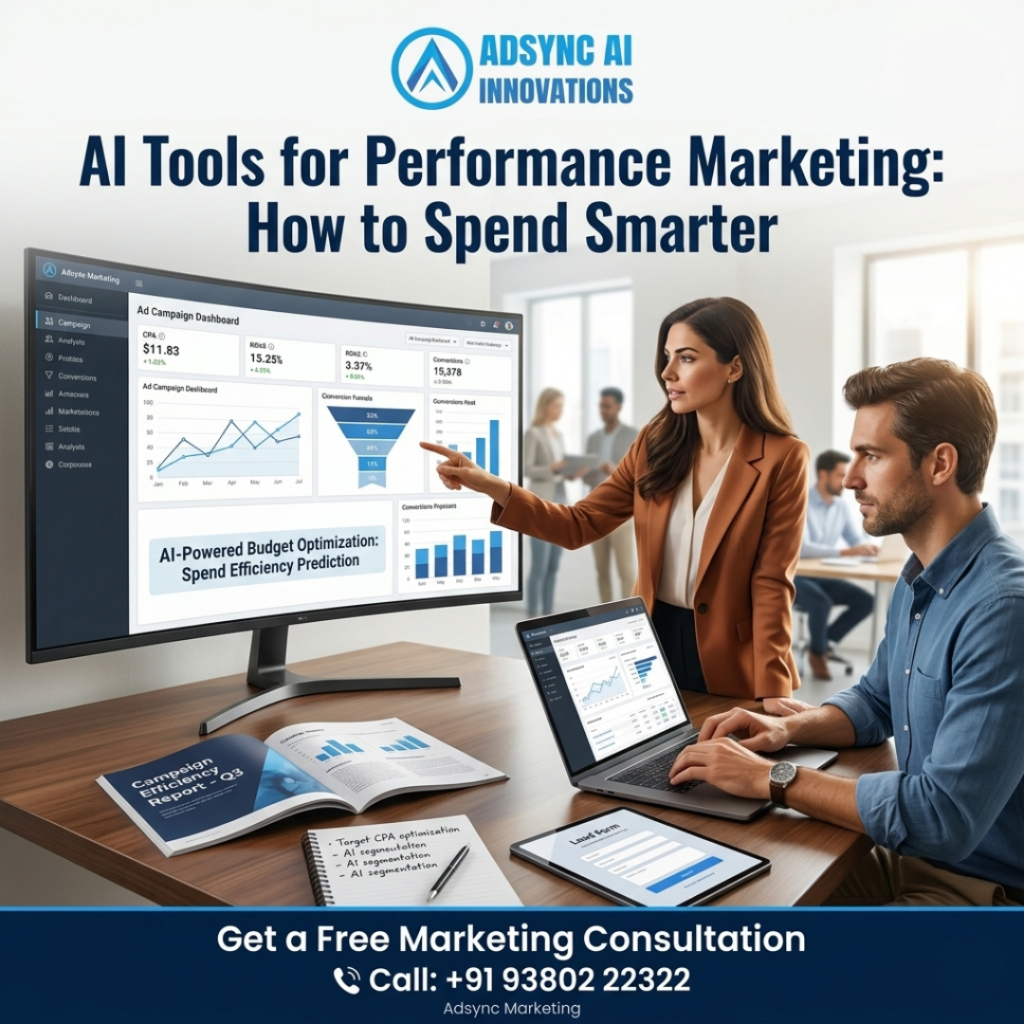
First, running paid ad campaigns is getting harder. Specifically, ad costs on Google and Meta are increasing. Furthermore, tracking users is more complicated today. Trying to manually test dozens of different ad creatives is completely exhausting.
Consequently, if you manage digital advertising for an Indian brand, you cannot afford to calculate bids manually. You cannot simply guess which ad image will work best.
Therefore, this is exactly where AI tools for performance marketing come in. You do not need a massive tech budget to use them. Ultimately, the best tools take repetitive, data-heavy tasks off your plate. As a result, they allow you to focus strictly on strategy and scaling your business.
Here is a practical breakdown of the tools that actually work in 2026. Discover how to use them, and learn which costly mistakes you need to avoid.
TL;DR: The Quick Takeaways
- Math Over Guesswork: First, AI replaces manual analysis with instant, predictive math to lower your CPA.
- Rapid Creative Testing: Second, platforms like AdCreative.ai generate and score ads instantly.
- Intelligent Bidding: Furthermore, native tools like Meta’s Advantage+ adjust bids automatically to win the cheapest clicks.
- Human Strategy Required: Finally, AI processes data, but humans must supply the strategy and cultural context.
How AI Tools Actually Support Performance Marketing
At its core, performance marketing is just math. Essentially, it revolves around acquiring a customer for less money than they spend with your business.
When you manage campaigns manually, you are severely limited. You can only analyze data so fast. For example, you might check a spreadsheet on Friday. Consequently, you realize you spent ₹10,000 on an ad that generated zero sales.
However, AI tools for performance marketing operate in real-time. They process thousands of data points instantly. Furthermore, they automatically shift your budget toward the best pin codes, age groups, and ad formats. Instead of manually turning off a failing campaign on Friday, an AI tool detects the drop on Tuesday afternoon. Next, it pauses the ad for you automatically.
Categories of AI Tools You Should Care About
You do not need an AI tool for every single task. Instead, focus strictly on the core categories that directly improve your ROAS (Return on Ad Spend).
1. Ad Copy and Messaging
Staring at a blank screen takes too much time. Fortunately, tools like Jasper or ChatGPT can generate twenty different headline variations in seconds. First, ask the AI to write a version focusing on a discount. Next, ask for another version emphasizing product quality.
2. Creative Testing and Generation
The visual part of your ad makes people stop scrolling. Platforms like AdCreative.ai or Midjourney generate high-quality ad variations rapidly. However, always double-check the final output. Sometimes, AI inserts the wrong logo. Therefore, explicitly prompt the AI to include a clear “Call to Action” button.
3. Audience Research
AI tools can quickly scrape competitor websites. Furthermore, they analyze customer reviews perfectly. Consequently, they tell you exactly what your audience hates. You can use those insights to target specific pain points.
4. Bidding and Campaign Optimization
Native tools handle bidding automatically. For example, Google uses Performance Max (PMax). Meta uses Advantage+. Instead of guessing a click’s worth, the platform predicts user behavior. Consequently, it adjusts your bid in real-time to win the cheapest auction.
5. Landing Page Optimization
Sending ad traffic to a slow website wastes money entirely. AI tools like Unbounce or Surfer SEO analyze your landing page instantly. They tell you exactly what words to change to get more conversions.
6. Analytics and Reporting
Nobody likes building weekly spreadsheets. Fortunately, analytics tools like Triple Whale or Segwise monitor your campaigns 24/7. In fact, Segwise provides deep creative intelligence across multiple networks. They instantly notify your team on Slack if your cost per lead suddenly spikes.
7. Marketing Automation
Tools like Klaviyo use AI to automate the post-click experience. If someone adds a product to their cart but abandons it, automation tools step in. They wait for the perfect moment. Next, they send a personalized email to recover the sale.
Practical Examples for Indian Businesses
How does this look in the real world? Here are a few ways Indian companies apply these tools right now.
Example 1: A Healthcare Facility in Bangalore
First, a local hospital runs Google Ads to increase patient visits. Instead of manually guessing search terms, they use an AI analytics tool. This tool tracks which keywords result in booked appointments. Consequently, the tool automatically moves budget into high-converting service keywords.
Example 2: A D2C Skincare Brand
Next, an e-commerce brand uses an AI creative tool to generate fifty image variations. The AI tests all fifty images with a small budget. Within 48 hours, the tool identifies the winning image. Finally, it turns off the losers and scales the winner automatically.
Example 3: A B2B Tax Consultancy
Finally, a firm needs highly qualified leads. They use AI writing tools to outline 50 blog posts about new GST rules. This creates a massive funnel of educational content. Ultimately, it lowers their ad costs because the audience arrives warmed up.
Free or Low-Cost AI Tools for Small Businesses
If you have a tight budget, you do not need enterprise software.
- ChatGPT or Claude (Free/Low Cost): Use these for brainstorming ad copy and summarizing reviews.
- Canva Magic Studio (Low Cost): This is excellent for generating quick, branded ad visuals automatically.
- Google Analytics 4 (Free): GA4 features built-in AI insights. You can type a question, and the AI generates an instant report.
- Meta Advantage+ (Free to use): The AI bidding is built directly into Facebook Ads Manager.
What AI Tools Cannot Replace
AI acts as a calculator, not a strategist. It processes data perfectly, but it lacks business context.
For instance, an AI tool does not know your inventory is delayed in Mumbai. It does not understand the cultural nuance of a local festival. Most importantly, AI cannot build genuine empathy.
If you let AI run unchecked, it might spend your budget on cheap mobile game clicks. Therefore, you always need a human marketer to set the overall strategy.
Common Mistakes Brands Make
When marketing teams first adopt these tools, they usually make predictable errors:
- Turning campaigns off too early: AI bidding algorithms need data to learn. If you turn a campaign off after two days, you ruin the learning phase.
- Ignoring the data quality: AI remains only as smart as your tracking. If your pixel is broken, the AI optimizes for the wrong audience.
- Using generic prompts: If you simply ask an AI to “write a Facebook ad,” you get a robotic result. You must feed it specific details about your unique offer.
A Practical Checklist for Choosing the Right Tool
Before you buy a new AI platform subscription, run through this checklist:
- First, does it solve a real bottleneck?
- Second, does it integrate perfectly with your current setup?
- Next, is the data actually accurate?
- Finally, can your team actually use it without months of training?
Partner with an Agency That Understands AI
Using AI tools for performance marketing is no longer optional. If you want to scale predictably, you must embrace automation.
However, piecing together software and fixing pixel tracking takes time away from running your business. You do not have to manage it all yourself.
At Adsync, we operate as an AI-driven branding and performance marketing agency in Bangalore. We combine raw processing power with human-led business strategy. We build data-backed campaigns designed to increase your bottom line.
If you are ready to modernize your ad campaigns, reach out to the Adsync team today. Let’s build a smarter strategy together.
- Call us: +91 93802 22322
- Email us: info@adsyncmarketing.com
- Visit: https://adsyncmarketing.com/