
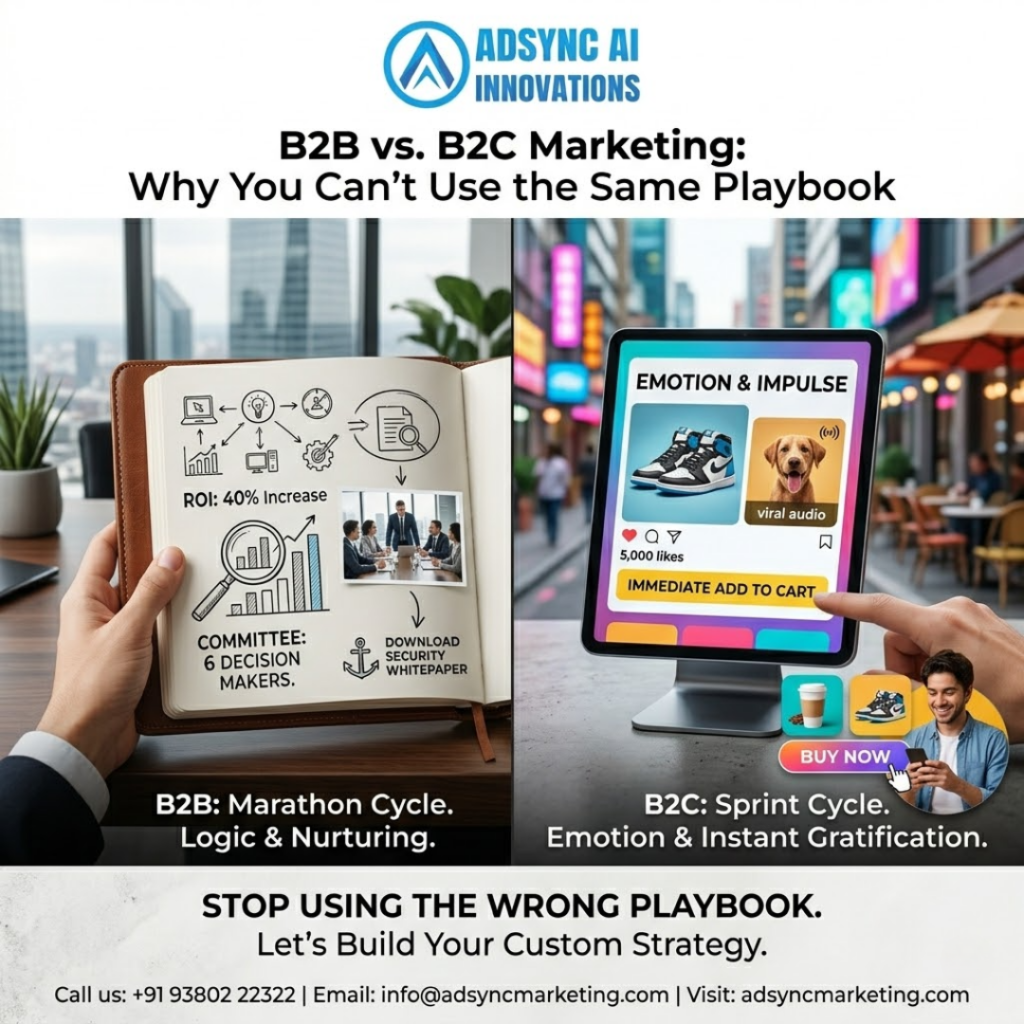
It is a trap that many growing companies fall into. You see a trendy, highly visual marketing campaign from an e-commerce brand completely blowing up on Instagram. They are using viral audio, colorful memes, and influencer shoutouts. It is driving massive revenue for them.
So, you decide to copy their strategy to sell your high-ticket, enterprise software to corporate executives.
The campaign launches, the budget is spent, and the result is total silence: no leads, no booked demos, and zero revenue.
Why did it fail? Because you tried to sell to a business using consumer psychology. While B2B (Business-to-Business) and B2C (Business-to-Consumer) marketing both fundamentally rely on human-to-human communication, the context in which those humans make decisions is radically different.
If you do not align your marketing strategy with your buyer’s exact psychological state, your message will miss the mark. Here is a breakdown of why B2B and B2C marketing require completely different playbooks, and how to optimize your approach for your specific audience.
TL;DR: The Quick Takeaways
- Emotion vs. Logic: B2C buyers want to feel good right now. B2B buyers need to prove Return on Investment (ROI) to their boss.
- The Soloist vs. The Committee: In B2C, you only have to convince one person. In B2B, you have to convince an average of six different decision-makers.
- The Sprint vs. The Marathon: B2C sales cycles can take as little as 10 minutes. B2B sales cycles can take ten months.
- Platform Alignment: Trying to sell ₹10,00,000 worth of industrial machinery through TikTok dances will destroy your brand authority.
1. The Buying Psychology (Impulse vs. ROI)
Think about the last time you bought a ₹2,000 pair of sneakers online. Did you build a spreadsheet comparing the exact rubber density of the soles? No. You bought them because they looked cool, they were on sale, and they made you feel good. B2C marketing is heavily driven by emotion, status, and instant gratification.
Now think about a Procurement Manager buying a ₹5,00,000 inventory management software system for their warehouse. They are not buying on impulse. If they choose the wrong software, the company loses money, and they might lose their job. B2B marketing is driven by logic, risk mitigation, and financial ROI.
The Action Step: Look at your website copywriting. If you are B2C, focus on the emotional benefit (“Feel confident in your own skin”). If you are B2B, focus on the hard metrics (“Reduce data entry errors by 40% and save your team 15 hours a week”).
2. The Decision-Makers (Convincing the Committee)
In B2C marketing, the person viewing your ad is usually the one who holds the credit card. You only have to overcome one person’s objections.
In B2B marketing, the person doing the research is rarely the person signing the final check. An HR manager might find your software, but they need approval from the IT Director (for security) and the CFO (for budget). You are dealing with a buying committee.
The Action Step (for B2B): You must arm your “champion” (the person who found you) with the tools they need to sell your product to their boss. Do not just rely on flashy landing pages. Create downloadable, highly detailed PDF case studies, security whitepapers, and ROI calculators that they can easily forward to the CFO.
3. The Sales Cycle (Immediate vs. Nurtured)
Because B2C products are usually lower cost and carry less personal risk, the sales cycle is incredibly fast. A consumer can see an ad for a coffee subscription box on Monday and be a paying subscriber by Monday afternoon.
B2B sales cycles are a marathon. A corporate buyer will spend months researching, comparing competitors, reading reviews, and attending demos before making a final decision. If you aggressively push for a hard sale on day one, you will scare them away.
The Action Step: Map your marketing to the cycle.
- B2C: Focus on urgency. Use limited-time discount codes, abandoned cart emails, and dynamic retargeting to close the sale quickly.
- B2B: Focus on lead nurturing. Capture their email address with a high-value industry report, and put them in an automated, 6-week email sequence that slowly drips out educational content and builds deep trust over time.
4. Channel Selection (Where Do They Hang Out?)
Just because a marketing channel is popular doesn’t mean your target audience is in a buying mindset when they use it.
If you sell organic dog treats (B2C), visually driven platforms like Instagram, Pinterest, and TikTok are goldmines. Your audience is looking to be entertained, and a cute video of a dog eating a treat aligns perfectly with their mood.
If you sell commercial office leasing (B2B), your audience is not looking for office space while scrolling TikTok at 9:00 PM. They are looking for it on LinkedIn or actively searching Google for “commercial real estate agents in Bengaluru” at 10:00 AM on a Tuesday.
The Action Step: Stop trying to be everywhere at once. If you are B2C, double down on highly visual social media and influencer partnerships. If you are B2B, invest heavily in Search Engine Optimization (SEO), Google Ads (Search Network), and LinkedIn thought leadership.
Stop Using the Wrong Playbook
Marketing is not a one-size-fits-all endeavor. The tactics that sell a ₹500 consumer product will completely sabotage a ₹50,00,000 corporate contract. You must intimately understand your specific buyer’s fears, desires, and constraints.
Are your marketing efforts bringing in the wrong type of leads (or no leads at all)? Your strategy might be misaligned with your audience’s psychology. The team at Adsync Marketing specializes in building custom-tailored marketing ecosystems—whether you need to drive thousands of fast B2C sales or capture high-ticket B2B enterprise clients.
- Call us: +91 93802 22322
- Email us: info@adsyncmarketing.com
- Visit: https://adsyncmarketing.com/