
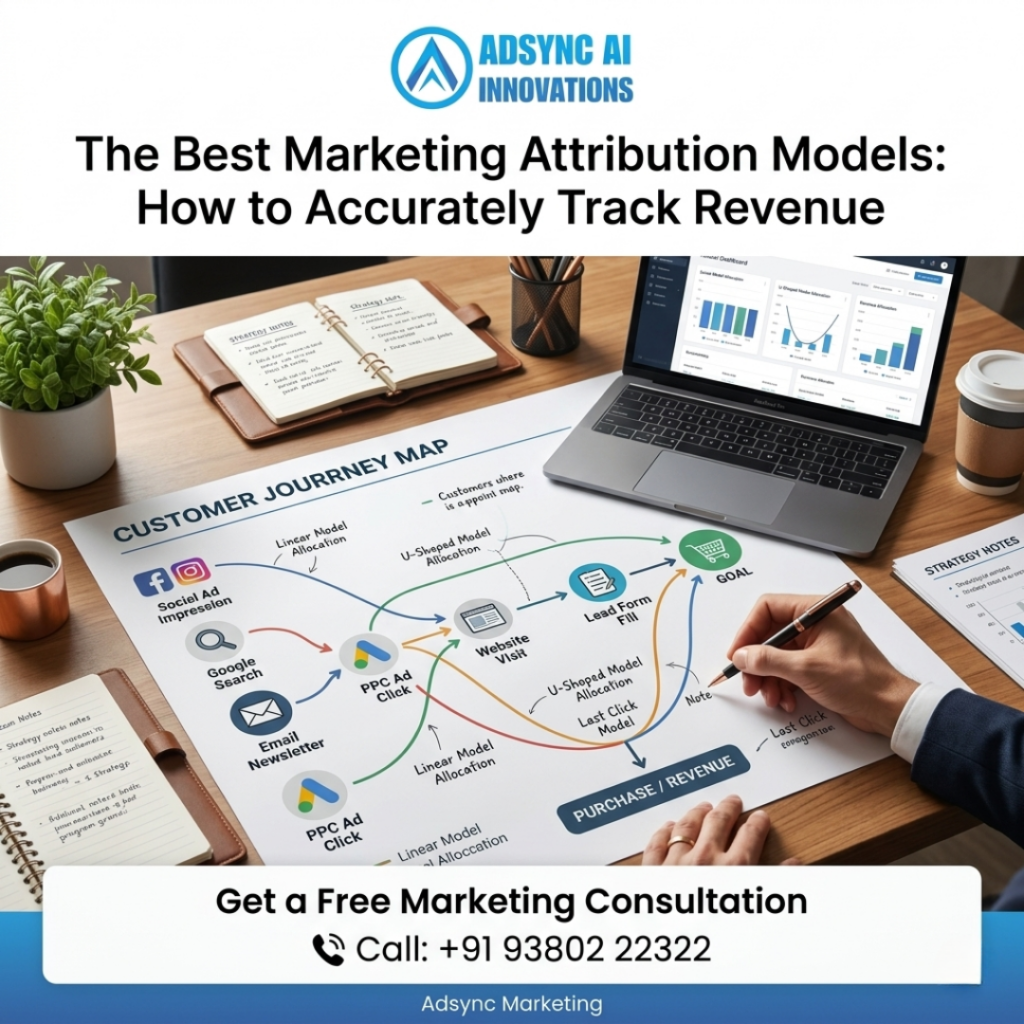
First, if you run ads on multiple platforms, you certainly face a frustrating math problem. At the end of the month, you pull your reports. Specifically, Meta Ads claims it drove 50 sales. Meanwhile, Google Ads claims it drove 40 sales. Furthermore, email marketing claims it drove 20. If you add those up, your marketing efforts seemingly generated 110 sales.
However, when you open your Shopify dashboard or your CRM, you only see 75 total sales. Therefore, who is lying? Exactly where did those extra sales come from?
The truth is, nobody is lying. Instead, they simply use different rules to claim credit for the exact same transaction. Consequently, this overlapping data makes it incredibly difficult to know where you should actually spend your budget next month. If you want to stop guessing and start making accurate financial decisions, you must deeply understand marketing attribution.
Here is a practical, no-nonsense guide to the best marketing attribution models in 2026. Discover exactly how they work, and learn which one your business should actually use.
TL;DR: The Quick Takeaways
- The Overlap Problem: First, ad platforms inherently overlap and double-count sales. Therefore, you absolutely need a single source of truth like GA4.
- Last-Click is Flawed: Second, giving 100% of the credit to the final click completely ignores the top of your marketing funnel.
- Data-Driven Wins: Furthermore, in 2026, machine-learning models intelligently distribute credit based on actual, mathematical impact.
- Match Your Sales Cycle: Finally, fast e-commerce brands require completely different attribution models compared to long-cycle B2B SaaS companies.
What is Marketing Attribution? (And Why is it a Mess?)
Marketing attribution is simply the strict rulebook you use to assign credit for a sale.
Think of a customer’s journey exactly like a game of football. First, the defender passes the ball to the midfielder. Next, the midfielder passes it to the striker. Finally, the striker kicks the ball and scores the goal. Therefore, who gets the credit? Does the striker get 100% of the glory just because he took the final shot? Alternatively, does the midfielder get half?
In digital marketing, the customer journey rarely follows a straight line. For example, a user might see your ad on Instagram on Monday. Next, they search for a YouTube review on Wednesday. Then, they click a Google Search ad on Friday. Finally, they buy through a retargeting email on Sunday.
If you assign 100% of the credit to the email, you will assume Instagram and Google are totally useless. Consequently, if you turn those ads off, your sales will crash because you removed the top of your funnel. Ultimately, choosing the right attribution model ensures you completely understand how your diverse channels work together to improve ROAS.
The Standard Marketing Attribution Models Explained
Most analytics platforms offer a few standard, rules-based models. Here is exactly how they distribute the credit.
1. Last-Click Attribution (The Default Trap)
This model gives 100% of the credit to the very last link the customer clicked before buying.
- The Pros: First, it remains incredibly easy to track. It tells you exactly what closed the deal immediately.
- The Cons: However, it completely ignores the rest of the customer journey. It severely undervalues brand awareness campaigns but biases heavily toward search ads.
- Verdict: Most platforms enable this by default. However, relying solely on last-click remains a huge mistake for growing brands.
2. First-Click Attribution (The Awareness Tracker)
This model gives 100% of the credit to the very first interaction a customer had with your brand, regardless of how long they took to buy.
- The Pros: Specifically, it shows you exactly how people originally discover your business.
- The Cons: Conversely, it ignores all the hard work your retargeting campaigns and sales team did to nurture the lead.
- Verdict: This model works well for measuring top-of-funnel brand awareness. However, it proves terrible for measuring actual conversion efficiency.
3. Linear Attribution (The Participation Trophy)
This model takes the credit for a sale and splits it equally among every single touchpoint. If a customer interacted with four different ads, each ad gets 25% of the credit.
- The Pros: First, it actively acknowledges that the whole marketing funnel matters.
- The Cons: Unfortunately, it assumes every single interaction holds equal importance. Reading a single tweet gets the exact same weight as attending a 45-minute webinar. Ultimately, that is rarely accurate.
4. Time Decay Attribution (The Deal Closer)
This model gives some credit to every touchpoint. However, it gives the most credit to interactions that happened closest to the time of sale.
- The Pros: Specifically, it accurately reflects how a customer’s buying intent increases over time. Furthermore, it rewards the campaigns that actually pushed the user over the finish line.
- The Cons: Nevertheless, it still undervalues the initial discovery phase that originally introduced the customer to your brand.
5. Position-Based (U-Shaped) Attribution
B2B marketers often favor this model. Specifically, it assigns 40% of the credit to the first click (discovery). Next, it assigns 40% to the last click (conversion). Finally, it splits the remaining 20% evenly among anything in the middle.
- The Pros: Ultimately, it highly rewards the two most important milestones: finding the customer and officially closing the sale.
The Shift to Data-Driven Multi-Touch Attribution
If you actively scale a modern business, relying on rigid, rules-based models holds you back entirely. Ultimately, the best marketing attribution models in 2026 remain completely dynamic.
Data-driven attribution now acts as the standard in GA4 and most premium analytics platforms. Specifically, it uses advanced machine learning to assign credit automatically. Instead of using a fixed rule, the AI analyzes both your buyers and your non-buyers. Consequently, it calculates the actual mathematical impact of every specific ad.
For instance, data might show that people who click your LinkedIn ad convert at a 50% higher rate than those who do not. Therefore, the system dynamically assigns much more credit to that LinkedIn campaign. Ultimately, it represents the absolute most accurate way to measure your complex multi-touch customer journey.
How to Choose the Right Model for Your Business
You absolutely do not need to use the exact same model as your competitors. Instead, your choice should depend entirely on what you sell and how long your sales cycle takes.
For Indian D2C and Ecommerce Brands:
If you sell ₹999 t-shirts or ₹500 skincare products, your sales cycle remains very short. Generally, people buy on impulse. Therefore, for fast, transactional businesses, leaning heavily on Data-Driven or a Time Decay model works perfectly. You must know exactly which ads actively drive immediate sales today.
For B2B SaaS and High-Ticket Services:
Conversely, if you sell enterprise software or expensive real estate in Bangalore, your sales cycle might last six full months. The customer will likely interact with your brand twenty times before signing a contract. Therefore, for long sales cycles, a Position-Based (U-Shaped) or a robust Data-Driven model proves completely critical. You must accurately track the value of the initial whitepaper download just as perfectly as the final sales call.
Common Mistakes When Assigning Marketing Credit
Even with the right model, you can still ruin your data. Watch out for these traps:
- Looking at platform data in isolation: First, if you only look at the Meta Ads dashboard, it will take credit for everything it touches. Therefore, you absolutely need an independent, third-party analytics tool (like GA4 or your CRM) to act as the neutral referee.
- Changing models too often: Second, you cannot compare last month’s performance using a Last-Click model to this month’s performance using a Linear model. Pick a model that perfectly fits your business logic and stick to it securely.
- Ignoring offline data: Finally, a lead might come through a Facebook ad but close over a phone call two weeks later. In this case, the ad platform loses visibility entirely. Therefore, your attribution model must seamlessly tie into your CRM so offline sales feed back into your marketing data.
Build a Foundation You Can Trust
Navigating marketing attribution remains highly complex. However, it represents the only way to build a truly scalable business. When you finally understand exactly which channels actively drive your revenue, you can confidently scale your ad budgets without any fear of wasting money.
Setting up clean tracking parameters, configuring GA4 properly, and connecting your CRM to your ad platforms takes immense technical expertise.
If you feel completely tired of messy data and overlapping reports, we can help. As a leading performance marketing agency in Bangalore, Adsync specializes in building transparent, data-backed growth engines. We operate as a full-funnel digital marketing agency in India. This means we do not just launch ads. Instead, we build the exact tracking architecture required to prove their exact financial return.
Ready to get total clarity on your marketing spend? Reach out to the team at Adsync today. Let’s fix your analytics perfectly.
- Call us: +91 93802 22322
- Email us: info@adsyncmarketing.com
- Visit: https://adsyncmarketing.com/