
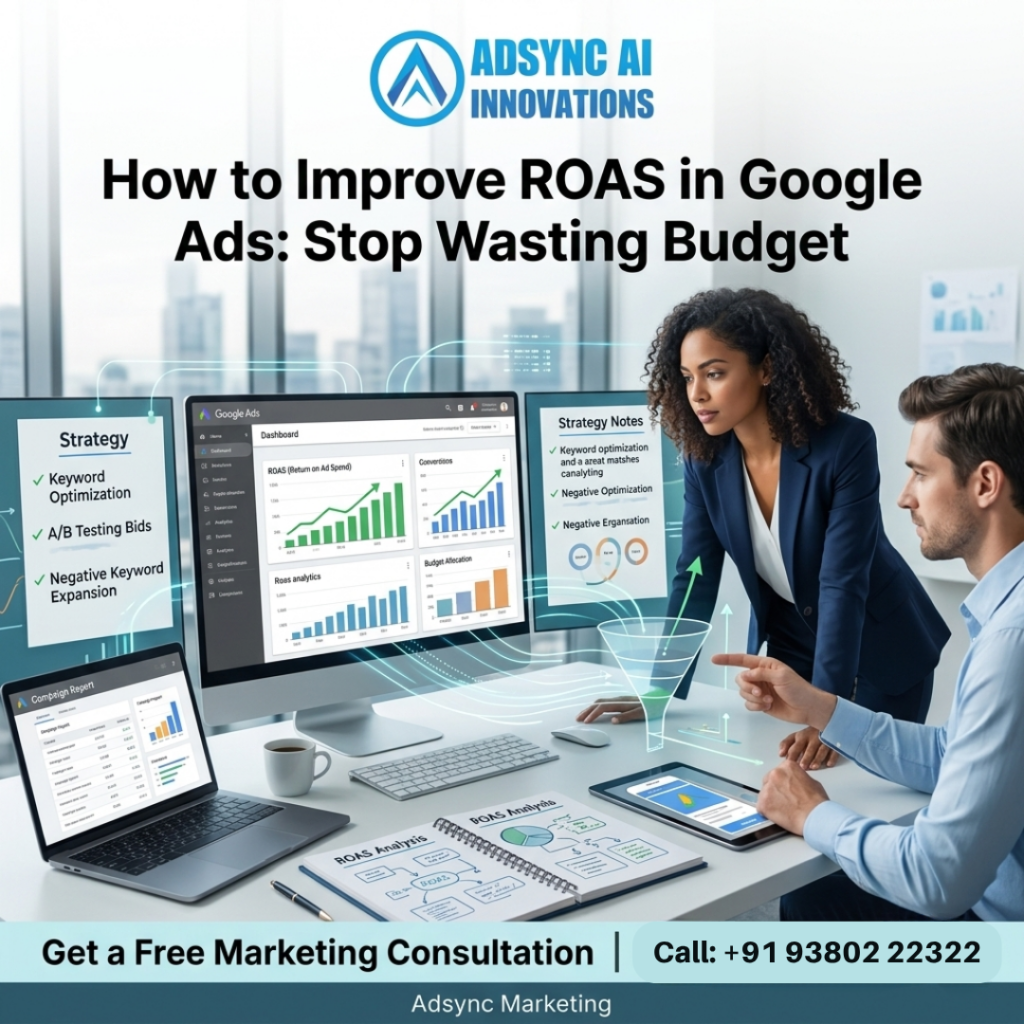
First, if you run paid search campaigns, you already know getting clicks remains easy. Specifically, Google will gladly take your money. Consequently, they will send hundreds of people to your website by tomorrow afternoon.
However, getting people to actually buy, book a consultation, or fill out a lead form presents an entirely different challenge. Furthermore, you must achieve this at a cost that keeps your business profitable.
Therefore, founders and marketing teams frequently stare at their dashboards. They wonder why their ad spend keeps climbing while their revenue stays flat. Ultimately, if your campaigns are bleeding cash, you do not need a complete overhaul. Instead, you must identify where the friction is happening and fix it.
Here is a practical, no-nonsense guide on how to improve ROAS in Google Ads. Discover how to eliminate wasted budget and turn your campaigns into a predictable revenue engine.
What is ROAS and Why Does It Matter?
ROAS stands for Return on Ad Spend. Essentially, it is a simple calculation. You divide the total revenue generated from your ads by your total ad spend.
For example, if you spend ₹10,000 on Google Ads and generate ₹50,000 in sales, your ROAS equals 5x (or 500%).
First, many amateur media buyers focus heavily on metrics like Cost Per Click (CPC) or Click-Through Rate (CTR). While those provide helpful indicators of ad health, they absolutely do not pay your payroll. You might have a brilliant CTR. However, if those visitors do not buy, your campaign fails entirely. Therefore, ROAS remains the ultimate metric. Specifically, it directly measures the financial efficiency of your marketing.
Practical Ways to Improve ROAS in Google Ads
Improving your returns isn’t about finding a secret setting in the dashboard. Instead, it is about aligning your ads with buyer intent and making the post-click experience completely seamless. Here is exactly how you do it.
1. Fix Your Conversion Tracking First
First, if you want to improve ROAS, you must track it accurately. Surprisingly, a massive number of ad accounts operate with broken conversion tracking. If Google does not know which specific clicks lead to actual sales, its algorithm cannot optimize your campaigns.
Therefore, move beyond basic tracking. Set up server-side tracking to capture data even when browsers block cookies. Furthermore, assign real monetary values to your conversions. If a lead form submission historically brings ₹2,000 to your business, tell Google immediately.
2. Shift from High-Volume to High-Intent Keywords
Second, traffic volume does not equal revenue. For instance, suppose you run a B2B tax consultancy. Bidding on a broad term like “accounting software” gets you thousands of clicks. However, most of them are students doing research or small businesses looking for free tools.
Instead, bid on high-intent, long-tail keywords like “corporate tax registration services in Bangalore.” Consequently, the search volume will drop significantly. However, the people typing that into Google already have their credit cards ready.
3. Aggressively Use Negative Keywords
Furthermore, negative keywords represent the easiest way to reduce your Cost Per Acquisition (CPA) instantly. Essentially, these are words you tell Google to ignore.
If you sell premium enterprise software, add words like “free,” “cheap,” “open source,” and “jobs” to your negative keyword list. Every time someone clicks your ad looking for a free solution, you lose money. Therefore, review your search terms report weekly and filter out the junk.
4. Write Ad Copy That Qualifies the Click
Next, most marketers try to make their ad copy as catchy as possible to maximize clicks. However, that is a huge mistake.
Your ad copy must act as a filter. If your product is expensive, put the starting price right in the headline.
- Weak Ad: “The Best Relocation Services in Dubai. Click Here.”
- Strong Ad: “Commercial Kitchen & Piano Relocation Specialists. Services start at ₹50,000.”
Consequently, the second ad gets fewer clicks. However, it completely filters out people looking for a cheap residential moving truck. Ultimately, you save money by actively repelling the wrong buyers.
5. Prioritize Landing Page Optimization
Google Ads only does half the job. Specifically, it gets the user to the door. Therefore, your landing page must close the deal.
If you pay ₹150 for a click and send that traffic to your generic homepage, your ROAS will plummet. Consequently, landing page optimization remains critical. The page must perfectly match the promise made in the ad. Make it load in under three seconds, and ensure the mobile experience works flawlessly.
6. Feed the Right Bidding Strategy
Manual bidding gives you control, but scaling efficiently remains impossible. Once your account consistently generates at least 30 conversions a month, transition to Smart Bidding. Specifically, test Target ROAS (tROAS) or Maximize Conversion Value.
As a result, Google’s machine learning adjusts your bids in real-time based on a user’s likelihood to purchase. It shifts your budget toward the most profitable traffic automatically.
7. Refine Audience Targeting and Remarketing
Finally, not all clicks hold equal value. You can layer audience targeting over your search campaigns. If you know your SaaS product targets users aged 30-55, adjust your bid modifiers to decrease spend on 18-24-year-olds.
Furthermore, use remarketing aggressively. A user rarely buys a high-ticket item on the first search. Therefore, create specific campaigns targeting people who abandoned their carts. Offering a small incentive to return often secures a cheap sale.
Common Reasons Google Ads ROAS Stays Low
If you have implemented the basics but your returns remain poor, look for these common culprits:
- Broad Match Chaos: Using broad match keywords without a massive negative keyword list shows your ad for irrelevant searches. Therefore, stick to exact match until you control your account.
- Ignoring the Post-Click Experience: A buggy checkout process or slow mobile site will destroy the best Google Ads optimization strategy instantly.
- Impatience: Machine learning takes time. Therefore, give major bidding changes at least 14 days to stabilize.
A Simple Checklist for Improving ROAS
Before you spend another rupee on Google Ads, run through this quick audit:
- Are conversion values assigned and tracking properly?
- Do you actively update your negative keyword list every week?
- Does your ad copy qualify the buyer with pricing or specific niches?
- Does every ad group link to a dedicated landing page?
- Are you bidding strictly on search intent rather than just search volume?
Partner with an Agency That Focuses on Revenue
Managing a profitable ad account requires constant attention to data. Furthermore, it demands deep keyword analysis and strict budget control. Handling effective Google Ads optimization while running your company remains incredibly difficult.
However, you do not have to manage it all in-house. If you need a Google Ads management agency in India that prioritizes bottom-line revenue, we can help.
At Adsync, we operate as a highly specialized AI-driven branding and performance marketing agency in Bangalore. We do not just optimize for clicks. Instead, we look at the full funnel to ensure your ad spend translates directly into revenue. As a leading Google Ads agency, we build data-backed campaigns designed to scale predictably.
Ready to stop wasting budget and start driving profitable growth? Reach out to the team at Adsync today.
- Call us: +91 93802 22322
- Email us: info@adsyncmarketing.com
- Visit: https://adsyncmarketing.com/