
For years, digital marketing “gurus” have been loudly declaring that email marketing is dead. They claim that everyone is on social media, nobody reads newsletters anymore, and email is a relic of the past.
They are completely wrong.
Statistically, email marketing still holds the highest Return on Investment (ROI) of any digital marketing channel. When you own your email list, you don’t have to worry about a sudden algorithm update hiding your content, and you don’t have to pay a tech giant every time you want to speak to your audience.
However, there is a catch. Email is only profitable if your emails actually reach the primary inbox.
If you are pouring your heart into writing weekly newsletters or promotional offers, but your open rates are hovering around a miserable 5%, your emails aren’t being read—the Spam or Promotions folders are swallowing them. Here is why internet service providers are blocking your messages, and how to rescue your domain reputation.
TL;DR: The Quick Takeaways
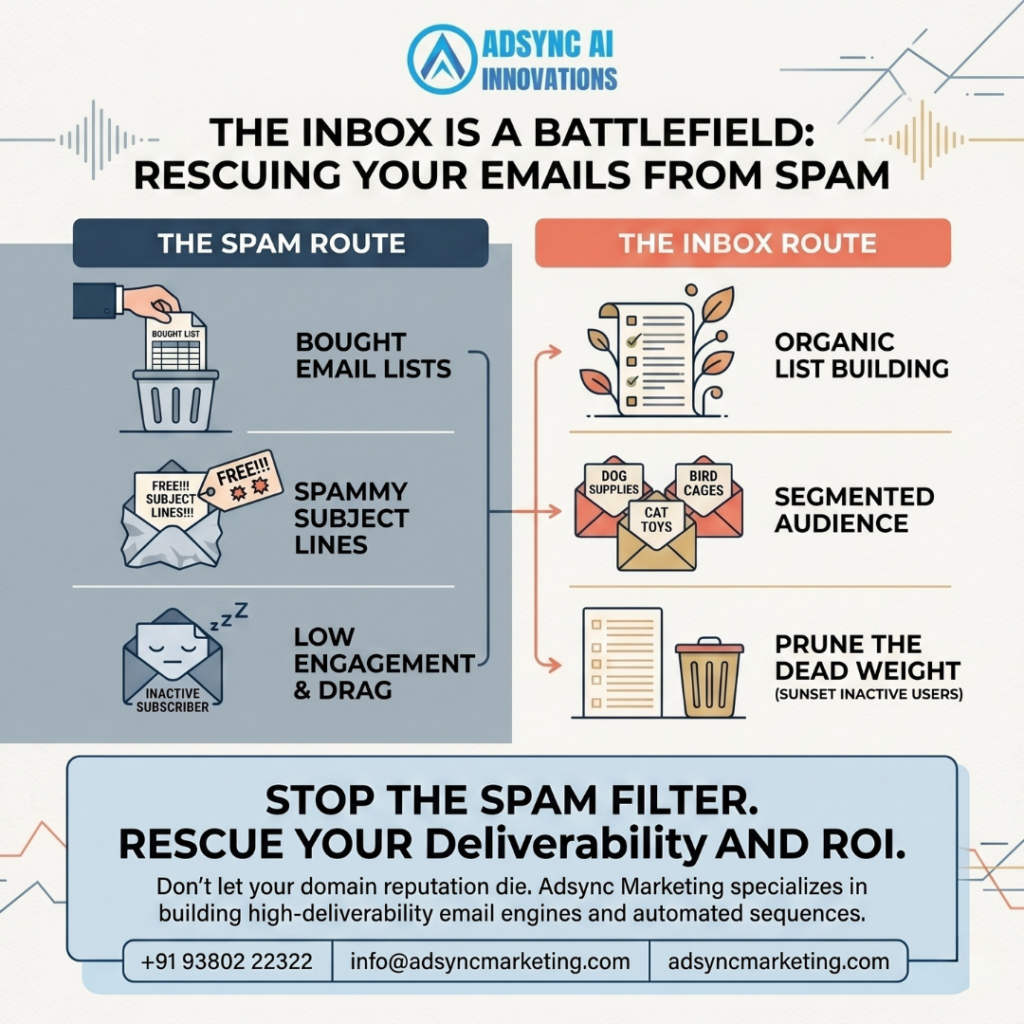
- Never Buy a List: Buying a spreadsheet of 10,000 random email addresses is a guaranteed way to destroy your domain’s sending reputation permanently.
- Avoid “Spammy” Subject Lines: If your subject line uses all caps, multiple exclamation points, or words like “FREE,” Gmail will aggressively filter it.
- Segment Your Audience: Sending the same email to everyone on your list results in low engagement.
- Prune the Dead Weight: Having a massive list is useless if half of them never open your emails. Deleting inactive subscribers actually boosts your overall deliverability.
1. You Bought a List (The Ultimate Reputation Killer)
It is the most tempting shortcut in the business world. You want to scale quickly, so you pay a data broker ₹15,000 for a list of 10,000 “highly qualified” industry contacts. You load them into your email software, hit send, and wait for the money to roll in.
Instead, two things happen: no one buys, and your email domain gets blocked.
Internet Service Providers (ISPs) like Gmail and Outlook are incredibly smart. They use “honeypot” email addresses—fake accounts planted in these purchased lists specifically to catch spammers. Furthermore, when you email people who never asked to hear from you, a large percentage will manually mark your email as “Spam.” When ISPs see this happening, they flag your entire domain (@yourcompany.com). Once you are flagged as a spammer, even the emails you send to your legitimate clients will start going to their junk folders.
The Action Step: Never, under any circumstances, buy an email list. Build your list organically by offering high-value Lead Magnets (like free industry reports, templates, or exclusive discounts) on your website in exchange for an email address.
2. Your Subject Lines Trigger the “Spam Filters.”
The spam filter is a highly sensitive digital bouncer. Its entire job is to protect users from scams, phishing, and aggressive salespeople.
If your subject line looks like this: “💥 HURRY! Buy Now and Get 50% OFF!!! 💥”, the bouncer is going to throw you right out the back door. Email providers look for specific trigger words and formatting choices. Using all capital letters, excessive punctuation, and heavily promotional words (like Free, Guarantee, Cash, Earn, Winner, or Urgent) sends a massive red flag to the algorithm.
The Action Step: Write subject lines like a human being writing to a friend, not a corporation shouting at a crowd. Keep it under 50 characters. Create curiosity without being deceptive.
- Instead of: “FREE CONSULTATION AVAILABLE NOW!!!”
- Use: “A quick question about your Q3 strategy.”
3. You Are “Blasting” Instead of Segmenting
Imagine you run an online pet supply store. A customer signs up for your email list specifically to get a discount on dog food. For the next three months, you send them weekly emails promoting cat litter, bird cages, and fish tanks.
They don’t own a cat, a bird, or a fish. They get annoyed and stop opening your emails.
When your open rates drop, ISPs assume you are sending low-quality content, and they start routing your future emails to the Promotions tab. This happens because you treat your email list as a single, monolithic megaphone rather than grouping people by their specific interests.
The Action Step: Segment your list. Divide your subscribers based on their past purchase behavior, their geographic location, or the specific lead magnet they downloaded. When you send highly relevant, targeted emails to a specific segment, your open rates will skyrocket.
4. You Are Afraid to Scrub the “Dead Weight.”
Business owners are emotionally attached to their subscriber count. If they have 5,000 people on their email list, they feel successful.
But what if 2,000 of those people haven’t opened a single email from you in over a year? Those “ghost” subscribers are actively dragging down your deliverability rate. ISPs look at your engagement ratio. If you send 5,000 emails and only 500 are opened (a 10% open rate), the algorithm thinks your content is boring.
The Action Step: It is time for some spring cleaning. Run a “Sunset Campaign.” Identify every subscriber who hasn’t opened an email in the last 6 months. Send them one final email saying, “Do you still want to hear from us? Click here to stay on the list.” If they don’t click it, delete them immediately. A list of 1,000 highly engaged readers is infinitely more profitable than a list of 5,000 people who ignore you.
Stop Shouting Into the Void
Email marketing is the ultimate tool for turning casual readers into loyal, repeat customers—but only if you respect the rules of the inbox.
Are your weekly newsletters ending up in the spam folder? It is time to rescue your domain reputation. The team at Adsync Marketing specializes in building high-deliverability email engines and automated sequences that actually get read.
- Call us: +91 93802 22322
- Email us: info@adsyncmarketing.com
- Visit: https://adsyncmarketing.com/